


Some people break loudly. Others collapse in silence.
If you’re the one still holding it all together on the outside—clocking in, parenting, returning texts—it can feel like no one would believe you’re using. Maybe even you barely believe it.
But here’s the thing: opioid addiction doesn’t always look like rock bottom. Sometimes it hides behind functioning. And the truth is, the longer you appear “fine,” the easier it becomes to believe help isn’t for you.
At Ladoga Recovery Center, we see clients like you every day—intelligent, responsible, exhausted people quietly fighting a battle no one knows about. And we want you to know: you don’t have to wait for everything to fall apart before you let someone in.
You Don’t Have to Lose Everything to Get Help
There’s a harmful belief that treatment is only for those who’ve “ruined” their lives. It’s not. You don’t need a DUI, an overdose, or an intervention to qualify for care.
Maybe you’re using opioids to take the edge off at night. Maybe you’re managing physical pain with pills you didn’t plan to depend on. Maybe it started as a way to keep up with long shifts or caretaking or grief—and now it’s something you can’t quite stop.
It doesn’t matter how your use began. What matters is how you feel now: tired, scared, and unsure how much longer you can hold this together.
Medicaid Covers More Than You Think
One of the most common questions we hear is: Will Medicaid actually cover this?
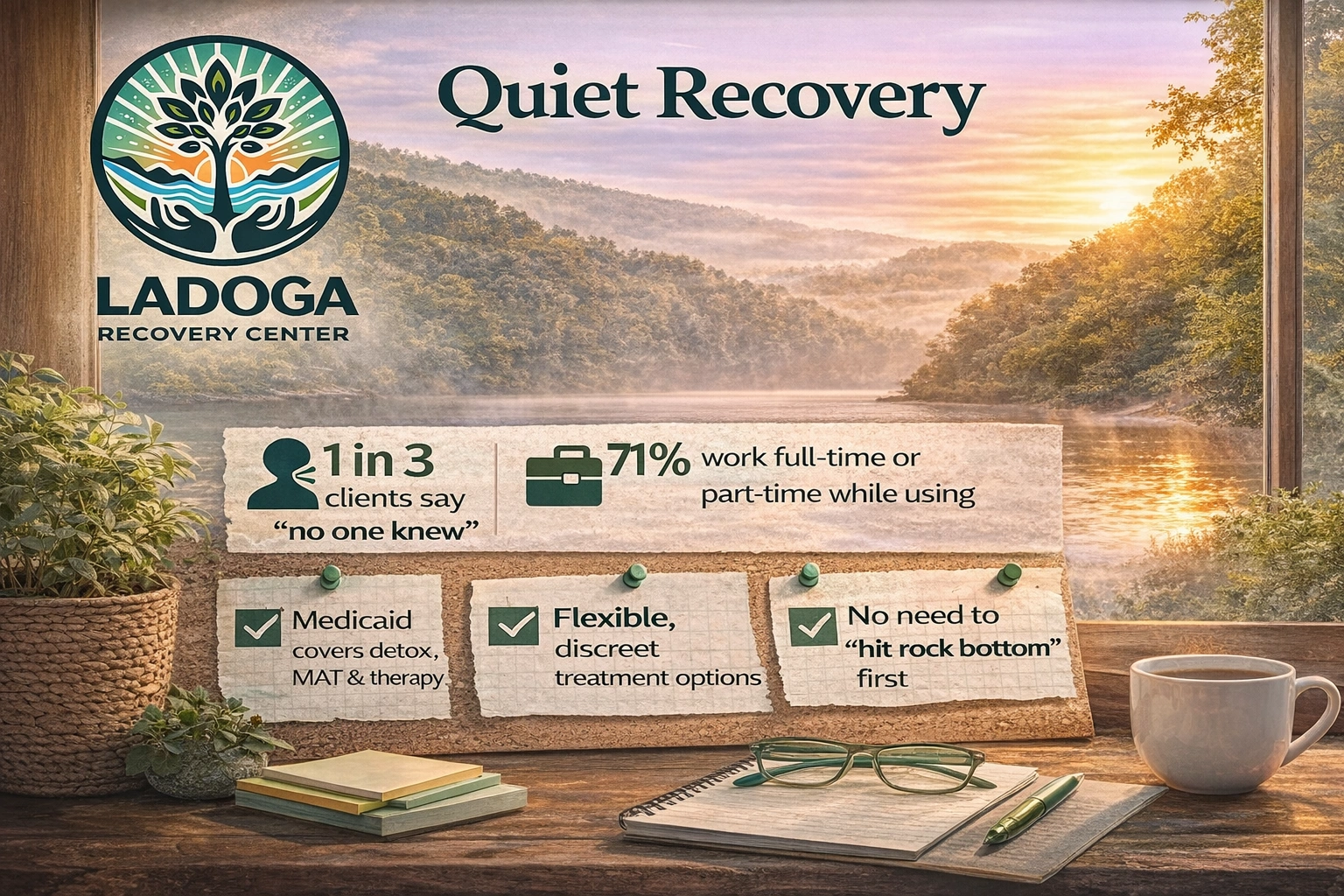
Yes. Indiana Medicaid covers opioid addiction treatment—including:
- Detox or stabilization
- Medication-assisted treatment (like Suboxone)
- Individual and group therapy
- Residential care if needed
- Outpatient services after discharge
We help you verify eligibility, handle authorizations, and coordinate next steps. You don’t have to navigate any of it alone.
You’re Not the Only One Living a Double Life
If you’ve thought:
- “No one would ever guess I have a problem.”
- “I’m not like those people who go to treatment.”
- “If I ask for help, I could lose everything.”
You’re not wrong for thinking that. Many high-functioning clients worry they’ll be judged—or worse, that they won’t be taken seriously because their lives don’t look like addiction from the outside.
We see you. We’ve treated nurses, teachers, business owners, stay-at-home parents, college students, even clergy. People who keep showing up, even as they’re quietly falling apart.
What Quiet Collapse Looks Like
Sometimes, collapse isn’t dramatic. It’s subtle. It looks like:
- Going to work hungover or under the influence, hoping no one notices
- Hiding pills in your glovebox or bathroom cabinet
- Using “just enough” to keep the panic down
- Missing joy, even as you keep meeting deadlines
- Wondering what would happen if anyone really knew
If you’re asking yourself whether it’s bad enough for treatment—it might be time to consider what good enough could feel like.
Success Story: “I Couldn’t Tell Anyone, So I Called You.”
One of our recent clients was a 41-year-old mom with Indiana Medicaid. She worked full-time, took care of her aging parents, and had three kids. No one suspected anything.
She told us on her first call: “I’m terrified someone at work will find out. But I can’t keep doing this.”
She admitted she was using painkillers every morning just to function—and taking more at night to come down. She wasn’t trying to party. She was trying to survive.
We walked her through her Medicaid options. She chose a short residential stay while her kids were with family. She started MAT. Today, she’s in outpatient care, still working, and hasn’t used in over seven months.
No one ever found out. Except the people who helped her heal.
Quiet Recovery Is Still Real Recovery
Recovery doesn’t need to be loud or public. At Ladoga, we protect your privacy. We tailor your treatment to your needs—not some idealized version of sobriety.
Here’s what you can expect:
- Flexible admissions process
- Optional medication-assisted treatment (MAT)
- Trauma-informed therapy that doesn’t lecture or shame
- Clear discharge plans and support after you leave
We don’t ask you to blow up your life. We help you build a life you don’t have to escape.
What Starting Looks Like—Even If You’re Not Sure Yet
You don’t have to walk in ready to change everything. You just have to take the first step. And it can be as simple as asking a question.
When you call us, we’ll:
- Listen without judging
- Explain how Medicaid works for opioid addiction treatment
- Walk you through treatment options (short-term, long-term, MAT, outpatient)
- Let you set the pace—no pressure, no scare tactics
There’s no wrong way to begin. But silence, eventually, stops serving you.
FAQs: Opioid Addiction Treatment for High-Functioning Clients with Medicaid
Is treatment really confidential?
Yes. Your privacy is protected by law. We follow HIPAA guidelines and respect your need for discretion. Whether you’re in a professional role, a caregiver, or a parent—we don’t share your information.
Will Medicaid cover my treatment if I’m still working?
Yes. Medicaid is based on income and eligibility, not employment status. Many working adults in Indiana qualify for Medicaid or the Healthy Indiana Plan (HIP). We’ll verify it for you before you commit to anything.
Do I have to stop everything in my life to go to treatment?
Not always. While residential treatment offers full support, we also provide outpatient options. Our team will help you choose a level of care that respects your responsibilities while addressing your needs.
Can I still take medication for pain or mental health?
Yes—with support. We’ll assess your full medical and psychiatric picture and coordinate care that works with your existing needs. If you’re on pain medication or antidepressants, we’ll help create a safe, transparent plan.
What if I’m afraid of withdrawal?
That’s valid—and manageable. We offer medical detox and MAT to help ease withdrawal symptoms safely. You won’t have to do it alone, and we’ll support you through every stage.
What happens after treatment?
Before you leave, we’ll create a personalized discharge plan, including:
- Continued therapy
- MAT follow-up (if applicable)
- Referrals to outpatient programs near you
- Tips for maintaining privacy while staying accountable
We don’t discharge and disappear. We help you build a foundation that lasts.
If You’re Tired of Hiding—You’re Ready
You’ve held a lot together. You’ve shown up when no one knew what it cost you. But now, it’s time to let someone carry a little of the weight.
Your collapse doesn’t have to be dramatic to deserve care. Your pain doesn’t have to be visible to count. And your story doesn’t have to be public to be valid.
If you’re holding everything in place by a thread, it’s not too soon for help. It’s the perfect time.
You Can Start Quietly—and Still Change Everything
Call (888) 628-6202 to learn more about our opioid addiction treatment services in Ladoga, Indiana.
You don’t have to fall apart to start healing. You just have to stop pretending it’s fine.