

Early sobriety can feel a little like being dropped into a party you didn’t RSVP for, where everyone seems to know the dance but you’re stuck holding a lukewarm soda and wondering what to do with your hands.
Especially if you’re in your 20s.
While your friends are planning weekend bar crawls, you’re reading recovery blogs at midnight trying to remember how to breathe without substances in your system. And if you’ve just finished—or are considering starting—a detox treatment program, you might feel even more out of sync with the world around you.
But here’s the truth: detox isn’t the end of anything. It’s the beginning of you learning how to navigate sobriety in a way that’s real, sustainable, and even (eventually) kind of empowering.
These are the lessons that stick.
1. Withdrawal Isn’t Just Physical—It’s Deeply Emotional
Most people think detox is just about physical symptoms: nausea, sweating, maybe some shakes. And yeah, that part’s real. But what hits hardest is often the emotional withdrawal.
You’re losing your old coping strategy. The one that numbed you out when things felt overwhelming. Without it, the volume on everything turns up—anxiety, sadness, boredom, fear.
Detox treatment programs prepare you for this. They teach you how to ride those waves without drowning in them. How to notice what’s coming up and respond instead of react. It’s like emotional CrossFit for your nervous system—and it’s okay if you’re sore at first.
2. You’re Not a Failure for Getting Help Early
If you’re in your 20s and already in detox, it’s easy to feel like the “youngest one” or “too young to be here.”
You’re not. You’re just smart enough to catch the spiral before it pulls you under. Addiction doesn’t check IDs. Burnout doesn’t wait until your 30s. And your life doesn’t need to be “bad enough” to be worth healing.
At Ladoga, there are people your age. People who drank to get through social situations. People who used to cope with stress, sadness, or just feeling off. You’re not the exception—you’re part of a quiet, growing community of people doing the hard thing early.
3. Silence Is Awkward at First—Then It Becomes Sacred
Your first few nights in detox might feel… loud. Not because people are yelling—but because your thoughts are doing gymnastics.
No phone. No numbing. No busywork. Just you and your head.
But something shifts. After a few days of guided structure, intentional rest, and gentle care, that silence stops screaming. It softens. You learn how to be with yourself—not always comfortably, but with more curiosity than fear.
That’s not just detox. That’s healing.
4. Your Body Is Relearning Safety, One Breath at a Time
Detox isn’t just about removing substances—it’s about slowly convincing your body that it doesn’t need to be in panic mode all the time.
You start to sleep again. Eat again. Laugh without it being forced. Your nervous system, frayed from constant stress or use, begins to believe it’s safe. And in that safety, real clarity can start to form.
Detox programs guide this process. With medical support, calming routines, and spaces where you’re not expected to perform or explain. Just be.
5. You Can Be Honest—and Still Be Okay
Maybe this is your first time saying the words out loud: I was using more than I meant to. I don’t know how to stop. I feel lost.
In detox, that kind of honesty isn’t met with judgment. It’s met with nods. Maybe a small smile from someone who remembers saying the same thing. And then, a quiet response: Thanks for sharing that.
You learn that your story doesn’t have to be polished to be valid. You don’t need to have all the answers to deserve help.
6. Not Every Day Will Feel Productive—and That’s Fine
One of the weirdest parts about early sobriety is learning how to just be without a constant dopamine spike. Detox helps you detox from that urgency, too.
You’re not failing because you spent the day journaling and crying and walking slowly in the grass. You’re healing.
Detox programs give you permission to go at a human pace. No pressure to be “better” by next Tuesday. Just space to start rebuilding from wherever you are.
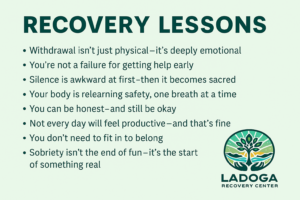
7. You Don’t Need to Fit In to Belong
Let’s be honest: recovery spaces can feel intimidating at first.
Maybe you’re not religious. Maybe you don’t relate to someone else’s story. Maybe you’re queer, neurodivergent, introverted, or just unsure how to “do” this whole recovery thing.
It’s okay.
Detox treatment programs like Ladoga don’t ask you to fit a mold. They welcome who you are—awkward, skeptical, searching—and help you feel seen. You don’t need to be like everyone else to heal in community.
8. Sobriety Isn’t the End of Fun—It’s the Start of Something Real
There’s this fear in early sobriety that everything fun is gone now. No more wild nights. No more spontaneous trips. Just… water and early bedtimes?
But detox teaches you something better: joy is different when it’s not followed by shame. Clarity hits different when you’re not constantly recovering from last night. And presence—real, grounded presence—can feel electric in its own right.
You might still have awkward moments. But you also start to realize: you’re not boring now. You’re becoming someone you can actually trust.
Detox Is the Foundation—Not the Finish Line
Detox is the start of your recovery, not the end. It clears the noise so you can start hearing yourself again. It calms the chaos enough to build a path forward.
And it reminds you—again and again—that healing isn’t about perfection. It’s about choosing yourself, one uncomfortable truth and one ordinary day at a time.
FAQ: Detox Treatment for Young Adults in Sobriety
Do I have to be physically dependent to go to detox?
No. Detox is also for emotional and psychological dependence—especially if your use is interfering with your ability to function, relate, or feel safe.
Is detox scary?
It can be uncomfortable, but it’s not something you have to do alone. At places like Ladoga, you’re supported every step—medically, emotionally, and relationally.
What happens after detox?
You’ll work with the care team to determine next steps, which may include residential treatment, outpatient care, or therapy. Detox clears the path—aftercare helps you walk it.
Will I be the youngest person there?
Maybe. Maybe not. But you won’t be alone. Many people in detox are in their 20s or early 30s. You’ll find people who understand—even if their story isn’t identical to yours.
Is it awkward to be sober at my age?
Yeah, sometimes. But awkward doesn’t mean wrong. Being young and sober can feel weird—but it also makes you strong, clear, and ahead of your time.
Want a Real Reset?
If you’re sober-curious, newly sober, or scared to take the next step, our Detox Treatment Programs in Indiana are here to help. Call (888) 628-6202 or visit the link to learn more. You’re not broken. You’re just beginning—and we’re here when you’re ready.