


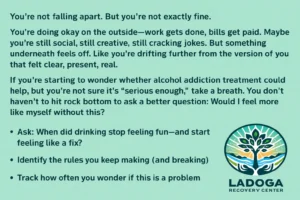
You’re not falling apart. But you’re not exactly fine.
You’re doing okay on the outside—work gets done, bills get paid. Maybe you’re still social, still creative, still cracking jokes. But something underneath feels off. Like you’re drifting further from the version of you that felt clear, present, real.
If you’re starting to wonder whether alcohol addiction treatment could help, but you’re not sure it’s “serious enough,” take a breath. You don’t have to hit rock bottom to ask a better question: Would I feel more like myself without this?
At Ladoga Recovery Center in Indiana, we work with people every day who haven’t crashed—but have quietly started to look for the exit. People who wonder, “Is this as good as it gets?” If that’s where you are, this blog is for you.
1. Ask: When Did Drinking Stop Feeling Fun—and Start Feeling Like a Fix?
There’s nothing wrong with enjoying a drink.
But there’s a shift that happens when alcohol turns into something you need to feel normal. Or to tolerate stress. Or to socialize. Or to fall asleep. Or to stop the noise in your head.
If you’re honest with yourself, you might notice:
- You’re drinking more nights than not
- You need more than you used to feel the same effect
- “I’ll just have one” rarely stays one
- Drinking isn’t always fun—it’s a habit that’s hard to break
Alcohol addiction treatment isn’t just for crisis-level use. It’s also for people who are tired of managing something that used to be simple—and now feels like it’s running the show.
2. Identify the Rules You Keep Making (and Breaking)
One of the most common early signs of a problematic relationship with alcohol? The quiet, personal rules.
Maybe you’ve said things like:
- “I’m only drinking on weekends now.”
- “No more drinking alone.”
- “Only one drink when I’m out.”
- “If I go out, I’ll take an Uber. I won’t risk driving again.”
These rules aren’t bad. They’re usually your body’s way of trying to protect you. But if you keep rewriting or breaking them, that’s not weakness. It’s a signal.
Needing to control your drinking constantly is itself a kind of loss of control.
You don’t have to label yourself to notice the pattern. But if your drinking keeps changing shape to fit around your life—it may be time to ask why it needs that much room.
3. Track How Often You Wonder If This Is a Problem
You don’t have to be in crisis to be concerned.
Many people in the sober curious space don’t think of themselves as “addicted”—but they do think about their drinking more than they’d like. They wonder:
- “Am I drinking too much?”
- “Why do I feel so anxious after I drink?”
- “Could I go a week without it?”
- “Why do I keep doing this when I don’t even enjoy it anymore?”
If alcohol weren’t a problem, you probably wouldn’t be reading this. And that doesn’t mean you need a diagnosis. It means your internal compass is trying to point you toward something better.
4. Reflect on Who You Were Before Alcohol Took Up So Much Space
When did you last feel clear?
Not just sober. But emotionally awake. Creative. Energized. Present.
Maybe alcohol helped you feel that way for a while—more fun, more bold, more open. But lately, you may feel like you’re chasing that feeling and coming up short. And in the process, you’ve started to lose touch with the real version of yourself.
That version of you—the one who doesn’t need a drink to feel good in their body, in their relationships, in their art or their rest—that version is still there. They’re not gone. They’re just waiting for the fog to lift.
At Ladoga, alcohol addiction treatment is built around that reconnection. Not punishment. Not shame. Just the chance to feel like you again.
5. Consider the Life You’re Quietly Craving
You don’t have to want a totally different life.
But maybe you want a morning where you wake up without regret. A night out where you remember the conversations. A relationship that doesn’t revolve around “who drank what.” A version of fun that doesn’t come with a three-day recovery.
That’s not about morality. That’s about alignment.
If alcohol is making your life look okay from the outside but feel wrong on the inside… you’re allowed to want different. Even if nothing’s on fire.
Especially then.
6. Understand What Alcohol Addiction Treatment Actually Offers
Treatment isn’t about stripping away your identity or turning you into a rule-following robot.
At Ladoga, it means:
- Clarity: Tools to understand what alcohol was doing for you—and what it was doing to you.
- Support: Staff and peers who don’t shame, rush, or lecture you.
- Structure: A path that fits your life—whether that’s outpatient, residential, or something in between.
- Reconnection: With your body. With your goals. With the parts of you that got buried under the buzz.
We won’t ask you to be sure. Just honest. Just curious. Just willing to see what might be possible.
FAQs for the Quietly Unsure
Do I have to hit bottom to go to treatment?
No. Many people come to us before anything “major” happens. You’re allowed to ask for help just because something feels off.
What if I’m not sure I have an addiction?
That’s okay. We help people understand their relationship with alcohol—without forcing labels or diagnoses. Curiosity is enough.
Will I have to go away for 30 days?
Not necessarily. We offer multiple levels of care, including outpatient programs that allow you to keep living your life while getting support.
Will I lose my personality or creativity without alcohol?
Absolutely not. Many people find their humor, spark, and creative energy grow in recovery. You don’t have to be numb to be interesting.
Can I talk to someone before deciding anything?
Yes. You can call just to ask questions. We’re here whether you’re ready to start, or just ready to think about starting.
You Don’t Have to Be Sure. Just Willing.
The fact that you’re even considering this means something is already shifting.
You’re not broken. You’re not doomed. And you don’t have to become someone else to get better.
You just have to be honest enough to ask: Is this still working for me?
And if the answer is no—you don’t have to fix it alone.
Still wondering if alcohol addiction treatment is right for you? Let’s talk.
Call (888) 628-6202 or visit our alcohol addiction treatment page to explore your options at Ladoga Recovery Center in Indiana—no pressure, just possibilities.