Wondering if CBT can help? If you or a loved one is struggling with addiction, mental illness, or both, we can help.

Home » Addiction Therapy Programs near Indianapolis, Indiana » Cognitive Behavioral Therapy
When your thoughts feel stuck, life can start to feel smaller. Worry grows, motivation drops, and old habits can take over. Cognitive behavioral therapy (CBT) is a practical, skills-based therapy that helps you break those cycles.
At Ladoga Recovery Center in Ladoga, Indiana, we use CBT along with other evidence-based therapies to support people facing substance use disorders, mental health challenges, or both.
CBT is not about blaming you for your thoughts. It is about learning new ways to respond so you can feel steadier, think more clearly, and move forward with confidence. We are here to help you heal, so reach out today.
Wondering if CBT can help? If you or a loved one is struggling with addiction, mental illness, or both, we can help.
CBT is a structured form of talk therapy that focuses on the connection between:
The main idea is simple: when you learn to change unhelpful thinking patterns and daily habits, you can change how you feel and how you cope.
CBT is active and goal-focused. Instead of only talking about the past, you also work on what is happening right now and what you want to improve.
In CBT, you and your therapist may:
Many people like CBT because it gives them tools they can use outside of sessions.
CBT is widely used for many behavioral health challenges, including:
CBT can also be helpful when symptoms show up as sleep issues, tension, difficulty concentrating, or feeling on edge.
For many people, substance use and mental health challenges feed each other. You might drink to calm anxiety, use drugs to escape depression, or relapse when stress spikes. CBT helps by teaching skills that work in everyday moments, not just in a therapy office.
CBT in recovery often focuses on:
When you are dealing with dual diagnosis, which is a substance use disorder that co-occurs with a mental health issue, CBT can help you treat the whole picture.
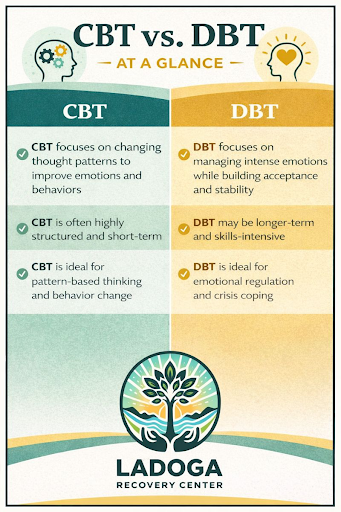
Cognitive behavioral therapy (CBT) and dialectical behavior therapy (DBT) are both evidence-based approaches. They share some roots, but they are used in different ways depending on a person’s needs. Understanding the difference can help you see why one or both may be recommended as part of treatment.
CBT focuses on how thoughts, feelings, and behaviors influence each other. The goal is to identify unhelpful thinking patterns and replace them with healthier, more realistic ones. This often leads to positive behavior change.
CBT is especially helpful when patterns like negative self-talk, avoidance, or rigid thinking are driving symptoms.
CBT is commonly used for:
CBT is structured, goal-oriented, and focused on practical skills that can be applied in daily life.
DBT was developed to help people who experience intense emotions and difficulty managing distress. While it builds on CBT principles, DBT places more emphasis on emotional regulation and acceptance.
DBT balances two ideas at once: accepting yourself as you are and working toward meaningful change.
DBT is commonly used for:
DBT typically includes skills training in mindfulness, distress tolerance, emotion regulation, and interpersonal effectiveness.
Both cognitive behavioral therapy and dialectical behavior therapy offer advantages, and both are often used in behavioral health treatment plans. Our team of compassionate professionals can help guide you toward the right starting point.
CBT gives you a toolbox. Your therapist will help you choose skills that match your goals and your current level of stability.
Examples include:
These skills can be applied to practical, real-life situations, helping you maintain sobriety and recovery.
Starting therapy can feel intimidating. We keep the process clear and supportive.
A typical CBT experience may include:
CBT benefits individuals with a wide variety of behavioral health issues. Its versatility is what makes it such a proven and effective therapy.
Mental health and substance use challenges affect families across Indiana, including communities in and around the greater Indianapolis area. The good news is that effective, evidence-based therapies like CBT can help.
Here are a few Indiana-focused data points that show why access to care matters:
If you see yourself or someone you love in these numbers, you are not alone. Getting support can be a real turning point.
Ladoga Recovery Center supports individuals and families in Ladoga and nearby communities. If you live in Montgomery County or you travel to the Indianapolis area for work, school, or family, help can still be close to home.
Find us at:
Ladoga Recovery Center: 8506 Academy Way, Ladoga, IN 47954
If you are unsure whether CBT is the right fit, we can talk it through and recommend a next step that matches your needs. Call (888) 628-6202 today to get started.
Whether you are new to your recovery journey or maintaining your life of sobriety, CBT can help. Let’s explore your treatment options today!
CBT is one of the most researched therapies and is widely used for anxiety, depression, and many other behavioral health concerns. It is especially helpful because it teaches practical skills you can keep using over time.
Yes. CBT is commonly used in addiction treatment because it helps you understand triggers, manage cravings, and build relapse prevention skills. It can also support mental health symptoms that make recovery harder.
CBT works well for dual diagnosis care because it addresses how thoughts, feelings, and behaviors interact across both challenges. Treatment can be tailored so you are not forced to choose which issue matters more.
Some people notice progress in a matter of weeks, while others benefit from longer-term support. The timeline depends on your goals, symptom severity, and whether you are also treating substance use or trauma.
In many cases, yes. Most private insurance plans cover Cognitive Behavioral Therapy when it is part of a medically appropriate treatment plan. Coverage can vary based on your provider, diagnosis, and level of care. Our admissions team can help verify your benefits and explain what your plan may cover.
Yes. If you are uninsured or have limited coverage, our team can discuss self-pay options and help you explore available payment arrangements. We believe cost should not be a barrier to getting help.
Ladoga Recovery Center believes you deserve care that feels practical, respectful, and hopeful. CBT can help you build skills for real life, whether you are working on anxiety, depression, substance use, or all of the above.
Reach out online or call (888) 628-6202 today to learn more about cognitive behavioral therapy in Ladoga, Indiana. We’re ready to help support your recovery.

 Aaron Davis
Trustindex verifies that the original source of the review is Google.
It is a great place to go I've struggled my whole life to find rehab centers that are worth the crap and this one hit the spot I actually did the 28 days and graduated got my certificate of completion the staff are wonderful people they actually care about your recovery the nurses as well shout out to all the ones that spent time individually to help me graduate they know who they are Jeremy SearcyIf you need help to get free from the obsession and compulsion of mood altering chemicals , Ladoga is the place. I truly don't have words to describe how great this place is! EVERYONE at Ladoga played a special part in helping me heal. Ladoga understands that each persons recovery journey is unique. The Love & Peace you will experience there is unmatched when it comes to treatment centers. The food is fabulous and you always get plenty to eat. A special thanks to the kitchen staff because they go above and beyond to prepare nutritious and delicious meals everytime. From the minute I got on the phone with Ladoga to the day I left , I was treated with respect and patience. And a special thank you for your patience ! BHT Julie, Atticus , Shelby & Andrew I LOVE YOU GUYS ! Therapist Lynn, Thank you for being one of my "100 Fathers" Patient Engagement Specialist Mike, Good looking out bro. And BHT Sofia, Thank you for being the Energy & Voice I needed at a crucial moment. I will always be indebted to everyone at LADOGA. So if you're tired of fighting addiction on your own, Call Ladoga .
 Lee AveryI just wanna say thank you to everyone there. Best staff you could ever hope for. I definitely have the tools to kick addictions ass. Love you guys thank you
 Kelly P.When you have to find a recovery center for a family member, it can be the most challenging time because you’re just not sure where to turn or what questions to ask. Ladoga Recovery made the process and journey so amazing! From the moment I spoke to Greg about intake, he was able to answer all my questions and make me feel so unbelievably comfortable about the difficult decision I was making. I cannot sing this facilities praises loud enough! They welcomed my family member in with open arms and have been so supportive along the way with keeping me updated and being an advocate as my family member is navigating things outside of the recovery center. Take it from a mom who only wants the best for their child… Ladoga Recovery is that place!
 Vanessa ReyesI am so thankful for places like Ladoga! Great staff who are committed to their work!
 Titus LeonThis place was so awesome the staff all the people from top to bottom were remarkably genuine in there care for all of us I had 2 leave because of a med emergency at my home they were very understanding I am trying 2 go back now as we speak
 Ashley JonesThis place saved my life. I hated to leave yesterday but I had no way to get my daughter back and forth to school for 28 days to complete the program. I was able to detox there and it's the most amazing program with the best staff. Nobody was judgemental and they were the most down to earth people there. I wish I could go back so bad. But I'm still sober! If you need help, please call this place. It will be the best decision of your life
 Dusty Morris#A place That Gave Me My Life Back... 😎 If you're reading this, there's a reason. Mabey you're hurting. Mabey you feel stuck. Mabey you've lost hope. I want you to know- I've been there... Today, I'm almost five months sober, living a life worth waking up for, and it all started at Ladoga Recovery. From the moment I walked in, the staff treated me with kindness, dignity, and respect. It wasn't just a facility- it truly felt like home. My therapist, Christina, was a gift. She listened, understood, and somehow knew what I was feeling even when I couldn't find the words. She met me where I was, and she helped me find the strength I didn't know i had. The rooms were comfortable, the environment was peaceful, and every detail was focused on helping me heal. I came to Ladoga by choice, and it was the best choice I’ve ever made. To anyone who's wondering if change is possible-yes, it is. If I can do it, so can you. Ladoga was the hand that reached out when I needed it most, and it can be that hand for you, too. To yours truly, Dusty, The Trucker.Verified by TrustindexTrustindex verified badge is the Universal Symbol of Trust. Only the greatest companies can get the verified badge who has a review score above 4.5, based on customer reviews over the past 12 months. Read more
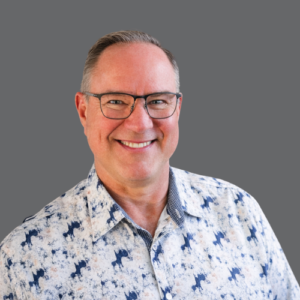
Tim Grzeskiewicz was raised in the Washington, DC Metro area and completed High School in Fairfax County Virginia before entering the United States Marine Corps where he achieved the rank of Seargent before being honorably discharged. Tim has worked several careers over the years, with his move into mental health and addictions being his final transition, which he refers to as his “move from success to significance”. Tim completed his undergraduate studies at Indiana University, graduating with honors and attending Huntington University for graduate school. Tim’s passion for the addictions population comes from his own experience with substance use issues and is currently a sober man in recovery with over 27 years of sobriety. Tim’s hope is to lead others in love and service to the sick and suffering.
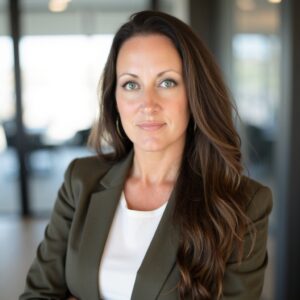
With over 25 years of experience in healthcare and more than a decade dedicated to nursing practice, Mandy brings a wealth of knowledge, leadership, and compassion to her role as Director of Nursing at Ladoga Recovery. She earned her Bachelor of Science in Nursing from Indiana University Northwest and has built a career spanning diverse clinical settings, developing expertise in patient-centered care, clinical operations, and team development.
Mandy’s dedication to the field of addiction recovery is not only professional but also deeply personal. Having walked alongside loved ones in the throes of addiction, she understands firsthand the challenges, heartache, and hope that come with the journey of recovery. This perspective drives her passion to ensure that every patient is treated with dignity, empathy, and respect.
Specializing in substance use treatment and recovery support, Mandy is committed to fostering an environment where patients receive safe, evidence-based care during one of the most critical times in their lives. Her leadership style emphasizes collaboration, staff education, and adherence to best-practice protocols to ensure the highest quality of care.
Passionate about guiding both patients and staff toward growth and resilience, Mandy continues to be an advocate for recovery-focused healthcare that not only supports healing but also transforms lives.
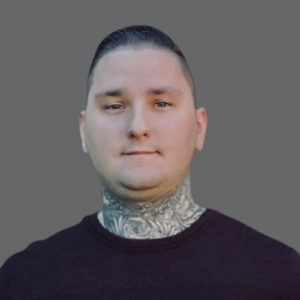
Ethan brings over six years of hands-on-experience in the substance abuse and mental health field, where he has built a career rooted in passion, resilience, and a deep commitment to helping other transform their live. Starting from an entry-level role and working his way up through the ranks, he’s gained a strong understanding of the challenges individuals face in recovery – both clinically and personally.
His journey in the SUD field has been fueled by a genuine passion for supporting individuals as they confront addiction and mental health struggles. He takes pride in meeting people where they are, creating a safe and supportive environment, and helping them recognize their own potential. Whether through patient facing positions or leadership roles, he has strived to show every individual that recovery is not only possible but within reach.
Throughout his career, he’s been recognized for his ability to lead with integrity, build trust, and foster growth – not only in the clients he’s served but also in the team’s he’s worked with as well. Ethan believes in leading by example, staying grounded in empathy, and always advocating for those who may not yet have the strength to advocate for themselves. Helping other discover their own path to recovery is more than a job to him, it’s a calling. Every step forward that he witnesses in someone else’s life journey reaffirms why he does this work and will be committed to this mission for years to come.

Cristina Monnett is an HR professional with over 12 years of experience supporting teams in manufacturing and healthcare. She partners closely with operations leaders in fast-paced, highly regulated environments to strengthen employee relations, ensure compliance, and implement practical, real-world people strategies. Cristina is passionate about creating workplaces where employees feel supported and organizations run smoothly.
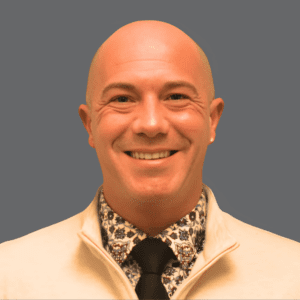
Shane Austin is a dedicated behavioral health professional, bringing a wealth of experience in the field of substance use disorder treatment. As a lifelong resident of Indiana and an alumnus of the Indiana University, Shane embodies a profound sense of empathy and understanding, deeply rooted in his own transformative four-year journey of recovery. This personal experience fuels his passion and relentless commitment to inspiring individuals to embrace the treatment that leads to lasting sobriety and fulfilling lives. By connecting those in need with essential resources, Shane skillfully utilizes his knowledge and personal narrative to illuminate the path to recovery for others, empowering them to embark on their own successful journeys.
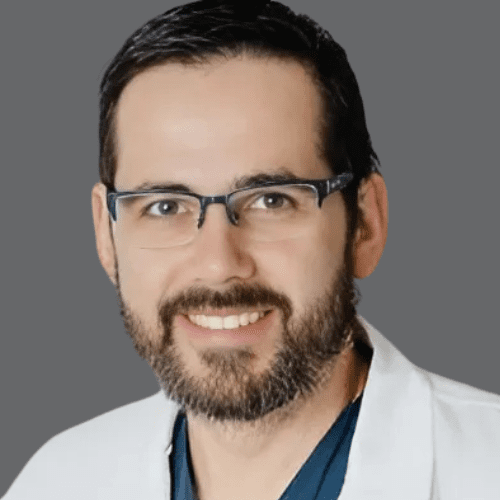
Dr. William Cooke is the Medical Director of Ladoga Recovery Center, an inpatient facility dedicated to providing comprehensive and compassionate care for individuals struggling with substance use disorders. With over two decades of experience in addiction medicine, Dr. Cooke leads the clinical team at Ladoga Recovery Center with a focus on evidence-based practices and patient-centered care.
As a board-certified expert in both Family Medicine and Addiction Medicine, Dr. Cooke brings a holistic approach to treatment, integrating medical, psychological, and social support to address the complex needs of individuals on their journey to recovery. Under his leadership, Ladoga Recovery Center emphasizes a “whole-person” philosophy, ensuring that each patient receives tailored treatment plans that foster long-term recovery and overall well-being.
Dr. Cooke is also a Fellow of the American Society of Addiction Medicine (ASAM), reflecting his commitment to advancing the field of addiction medicine through continuous learning, advocacy, and collaboration. At Ladoga Recovery Center, he is dedicated to creating a safe, supportive, and effective environment where patients can begin their path to healing.
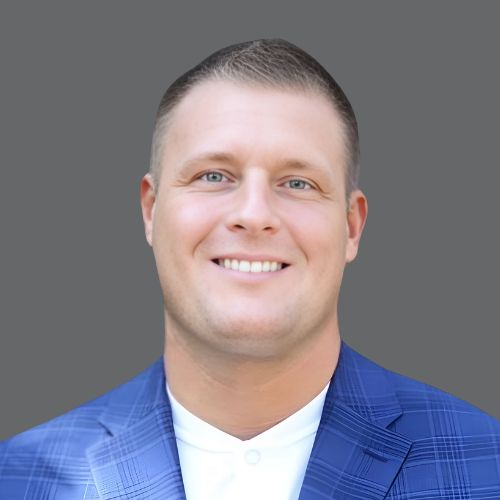
As Executive Director of Ladoga Recovery Center, Brian Foster brings nearly a decade of experience in behavioral health, specializing in substance use disorder and co-occurring mental health treatment. With a diverse background spanning from inpatient detox and residential care, sober living, outpatient treatment, and both the for-profit and nonprofit sectors, Brian is dedicated to creating comprehensive, holistic treatment programs. Holding a Business degree from Indiana University and graduate degree from Indiana Wesleyan University, Brian combines a strong foundation in business with a personal commitment to recovery, using his own experience to inspire and support others on their journeys. This broad background enables Brian to approach leadership with a well-rounded perspective on the complex needs of individuals in Recovery.
As a person in long-term Recovery, Brian is proud to lead a team that makes a meaningful impact on the lives of those struggling with addiction and helping them rebuild relationships with their loved ones. Living in Fishers, IN, with a supportive wife and two wonderful daughters, family is the heart of Brian’s life, bringing a deep commitment to building a community where individuals can find hope, healing, and a path forward.