


You thought the worst was behind you.
Maybe they had just completed outpatient. Maybe they were starting to laugh again, work again, function again. Maybe you even let yourself believe this chapter was over.
And then you found out: they’re using again.
If you’re here, reading this with a heavy heart, let’s pause together. Let’s take a deep breath.
Because while relapse is painful, it doesn’t mean hope is lost. It means something in their recovery plan wasn’t enough. It means a new kind of support may be needed. And an inpatient treatment program might be that support—if not forever, then for right now.
At Ladoga Recovery Center in Indiana, we walk with parents through this moment every single day. We know how devastating it feels. We also know how powerful it can be—if handled with care, not shame.
What a Relapse Really Signals
Relapse is not a failure of willpower. It’s not a betrayal of your parenting. It’s not even necessarily a sign that treatment “didn’t work.”
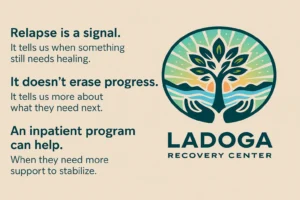
It’s a signal.
A signal that something still needs healing: a part of their brain, a part of their emotional world, a part of their life that makes being sober feel unsustainable right now.
Relapse often happens when a young adult:
- Leaves treatment too early
- Faces unresolved trauma or mental health challenges
- Returns to high-risk environments too quickly
- Lacks structure, purpose, or emotional regulation tools
This doesn’t erase their progress. It simply tells us more about what they need next. Sometimes that next step is more treatment. But often, it’s different treatment.
When to Consider an Inpatient Treatment Program
We know you’re weighing a hard decision. You might be thinking:
“Do I really want to put them back in treatment?”
“Won’t they just resent me?”
“Is this too soon—or too late?”
These questions are normal. But here are a few signs that inpatient care could be the right next step:
- Their use escalated quickly after a period of sobriety
- They’ve become emotionally volatile or withdrawn
- You’re afraid for their physical or emotional safety
- They’re not responding to check-ins, boundaries, or outpatient care
- They themselves seem scared, stuck, or hopeless
An inpatient treatment program in Indiana can provide what home can’t always offer: distance from triggers, 24/7 support, peer connection, and enough structure to stabilize emotionally and physically.
Sometimes the most loving thing you can do is change the environment—so they have a real chance to change the outcome.
What Inpatient Care Can Offer (That Other Levels Can’t)
Outpatient treatment is a critical part of the recovery journey—but it’s not always enough on its own, especially after a relapse.
Inpatient programs at Ladoga offer:
- Medical support for detox, psychiatric needs, or physical stabilization
- Daily therapeutic engagement including individual and group sessions
- Time away from enabling dynamics or substance access
- Safe space to rebuild internal motivation instead of external compliance
- Coordinated care that addresses mental health and addiction together
It’s not just about keeping them sober—it’s about giving them space to reconnect with who they are, and why they might want to stay.
What This Looks Like for Families
Let’s be honest: it’s not easy. Even when you know inpatient care is the right next step, getting your child to agree—or simply letting go for a few weeks—can be excruciating.
But you won’t be alone.
At Ladoga, we guide families through:
- The admissions process, including insurance and financial questions
- Talking to your child in a way that invites possibility, not punishment
- Family sessions during treatment that help rebuild trust and understanding
- Post-discharge planning, including next steps and support structures
We don’t just care for your child. We care for the system they come from. That includes you.
What Makes Second-Time Treatment Different
If your child has already been in treatment once, it’s natural to wonder: What would be different this time?
Here’s what we’ve seen:
1. More honesty. After a relapse, many clients drop the performative recovery act. They show up more raw—and more real.
2. Better insights. They’ve been through it once. They know what they avoided, what worked, what didn’t.
3. Renewed readiness. The consequences are clearer now. Many clients arrive more open to the process—not because they were forced, but because they’re tired of hurting.
4. A different plan. We don’t just redo the same curriculum. We adapt everything—from therapy type to group themes to aftercare—to meet who they are now, not who they were before.
Recovery isn’t linear. But with the right support, it can still be upward.
Stories of Hope from Families Who’ve Been Here
We’ve seen the relapsed 22-year-old who walked in angry and left with a plan.
The 20-year-old who’d bounced from house to house, finally able to stay sober and re-enroll in college.
The mom who called us sobbing and now speaks in alumni family panels, offering hope to other parents just starting this journey.
We don’t just believe in second chances. We plan for them.
Because relapse isn’t the end of the story. It’s a moment to rewrite the next chapter.
This Is Not Your Fault. And You’re Not Powerless.
If you’ve been blaming yourself, questioning every decision, trying to pinpoint when it all went wrong—you’re not alone.
But we need you to hear this:
- You did not cause their addiction
- You cannot control their choices
- You still matter deeply to their healing
What you can do now is make a choice to seek more support—for them and for you.
An inpatient treatment program isn’t giving up. It’s a courageous act of love.
FAQs for Parents Considering Inpatient Care After Relapse
How do I talk to my child about going back to treatment?
Stay calm and clear. Express concern without blame. Use “I” statements (e.g., “I’m worried about your safety”) and let them know inpatient care is about giving them a real chance to feel better—not punishing them for using.
Will my child be angry with me?
Maybe at first. But we’ve seen many young adults feel relieved once they’re in a safe space. With time and consistent support, most come to appreciate the decision—even if they resisted it initially.
What if they refuse to go?
You have options. Our admissions team can help you explore non-coercive ways to engage your child, or work with interventions if needed. You’re not stuck.
Does relapse mean the first treatment failed?
Not necessarily. It may have helped stabilize them or plant early seeds. Recovery often takes multiple steps. Each treatment experience builds on the last.
Can I be involved in their care while they’re in the program?
Yes. We offer family therapy, scheduled updates, and education to help you heal, too. You’ll be part of the journey—not just watching from the sidelines.
How do I know this will work?
There are no guarantees. But structure, support, and sustained engagement dramatically increase the chances of meaningful recovery. And we believe your child is never “too far gone” to benefit from care.
When You’re Ready to Take the Next Step
This isn’t where you thought you’d be. But it doesn’t have to stay this way.
If your child is using again—and you’re scared, sad, or unsure—know this: there is still a path forward. And you don’t have to walk it alone.
Call (888) 628-6202 or visit our inpatient treatment program page to talk with someone who understands what you’re going through and what options are available right now.
You are not a bad parent.
They are not a lost cause.
This can still turn around.