


If you’re here, chances are you’ve already started questioning your relationship with alcohol—not in the surface-level way people talk about “cutting back,” but in the quiet, searching way that starts from inside.
Maybe you’ve asked yourself:
“Why can’t I stop, even when I want to?”
Or…
“Why does drinking feel like the only way I can breathe?”
If so, you’re not broken. And you’re not alone.
At Ladoga Recovery Center, we work with people who’ve used alcohol not just to unwind—but to survive. And for many, the deeper story behind the drinking isn’t talked about enough:
Complex trauma.
Not the kind of trauma that comes from a single event—but the kind that builds over years.
The kind that’s quiet. Lingering. Hard to name.
The kind that convinces you that your feelings are too much—or don’t matter at all.
Here’s what most treatment paths don’t tell you when trauma is part of your drinking history—and why facing both together could change everything.
1. You Might Not Feel “Sick Enough” to Deserve Help
One of the first roadblocks many trauma survivors hit is the belief that someone else “has it worse.”
You might say:
“I’m not drinking all day.”
“I still go to work.”
“I’m just stressed—other people need help more.”
But functioning doesn’t equal healing.
And trauma often teaches us to minimize our own pain.
If alcohol feels like the only way to stay steady—or the only way to turn your brain off—that’s a sign, not a failure.
You don’t have to prove your suffering to qualify for care.
2. Your Drinking Might Have Protected You—Until It Didn’t
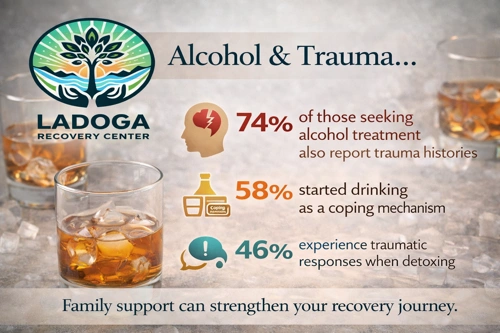
This one’s important: many people with trauma didn’t start drinking to rebel or party. They started to cope.
To stop the racing thoughts.
To make social interactions bearable.
To soften the fear of rejection.
To dull the ache of past neglect or emotional abandonment.
In the beginning, it may have worked.
But what numbs pain also numbs connection. And over time, that quiet glass becomes a shield that starts hurting more than it helps.
The hardest part of treatment is often saying goodbye to a coping mechanism that once saved you.
That grief is real—and it deserves space.
3. You May Feel Worse Before You Feel Better
When alcohol leaves the picture, trauma shows up louder.
Memories surface.
Dreams shift.
Feelings you haven’t touched in years come flooding back.
This is part of the process—not a sign that treatment is failing.
We help clients navigate these waves safely—especially through trauma-informed approaches like grounding work, nervous system regulation, and somatic support. At Ladoga, we don’t expect you to “just talk about it.” We build safety into every step.
You don’t have to re-live everything to heal. But you do deserve care that understands why those feelings are rising now—and how to hold them without fear.
4. Some People Won’t Understand Your Path—That’s Okay
You might be the first one in your family to question their relationship with alcohol.
You might have friends who say:
“You don’t need rehab—you’re not that bad.”
Or:
“You just need to learn moderation.”
People who’ve never used alcohol to self-soothe deep trauma often can’t see the depth of your struggle.
That doesn’t mean it’s not valid.
Part of trauma recovery is learning to trust your own reality—especially when others can’t. The fact that you’re curious about healing is enough.
You don’t need permission to begin.
5. You Might Long for the Person You Were When You Were Numb
Early sobriety is disorienting.
You might feel like your sense of humor disappears.
Like your social energy collapses.
Like everything feels raw and exposed—and you don’t recognize yourself.
This stage is temporary. But it’s real.
You’re not losing yourself. You’re re-learning who you are—without armor.
We often say: The you that survived with alcohol isn’t bad. She just didn’t have other tools yet.
In our trauma-aware programs, we honor every version of you. Even the one that drank. Especially the one that’s still scared.
6. You Don’t Have to Choose Between Trauma Work and Sobriety
A lot of programs treat alcohol misuse in one lane… and trauma in another.
But you can’t separate them. Not really.
If drinking was how you coped with panic, shame, abandonment, or abuse—then removing alcohol without addressing the root will feel like tearing off your skin.
That’s why our support in Substance Abuse includes trauma-informed care at every level—from early stabilization to treatment options in Crawfordsville.
You don’t have to choose between trauma work or sobriety.
You can have both—safely, slowly, sustainably.
7. Healing Might Feel Boring Before It Feels Good
This surprises many clients.
Drinking is often tied to high stimulation:
Risk. Drama. Emotional intensity. A nervous system that’s always on edge.
When that stops… life can feel boring.
That’s not a problem. That’s a sign of healing.
But you’ll need to learn what peace feels like—and that it’s safe to rest in it.
You may not feel “like yourself” at first—but that’s because the old self was surviving.
The new self gets to create a different kind of life.
8. You Don’t Need All the Answers to Begin
This is the quiet truth we see every day:
People don’t start treatment when they feel brave.
They start when they’re tired of being afraid.
You don’t need to declare lifelong sobriety.
You don’t need to know what your trauma was—or what to call it.
You just need to stay curious.
If something inside you says: Maybe there’s more for me than this,
That’s enough.
We’ll help with the rest.
FAQs About Trauma-Informed Recovery
Do I need to talk about my trauma right away?
No. At Ladoga, trauma work is paced based on your safety and readiness. We never push disclosures or emotional exposure before you feel stable and supported.
Can I still get help if I’m not sure I want to be sober forever?
Yes. Curiosity is a powerful place to begin. We work with many people exploring sobriety—not from a place of punishment, but from the hope of freedom.
Is my trauma “serious enough” for trauma-informed care?
If it affects how you cope, feel, or trust others—it matters. We work with all kinds of trauma, from obvious to invisible. You don’t have to justify your pain.
What if I’ve already tried treatment before and it didn’t stick?
That doesn’t mean you failed. Many programs treat symptoms but ignore trauma. If the root wasn’t addressed, the struggle makes perfect sense. This time can be different.
Can I stay connected to my loved ones during treatment?
Yes. We encourage supportive involvement and offer family education when appropriate—while protecting your boundaries and emotional safety.
You’re Not Too Late. You’re Right on Time.
If you’ve felt like your drinking story has always been about more than alcohol—you’re right.
If you’ve wondered whether something in your past still shapes how you show up now—it probably does.
And if you’ve been carrying that quietly, for years—you don’t have to anymore.
Call 888-628-6202 or explore our alcohol addiction treatment services in Indianapolis.
We’re not here to fix you. You were never broken.
We’re here to walk with you through the messy, brave, beautiful work of becoming whole.