


You walked out of treatment once—not by choice, maybe by desperation. You felt something crack: the commitments, the routines, the walls you built around yourself. You said you’d never return. But here you are again.
Returning to alcohol addiction treatment after a relapse—or after 90 days or more of sobriety—can feel like a wound reopening. It can also feel like a deeper chance to heal. In this second—or third, or fourth—turn, you carry memories, scars, and new insight. You know the stakes in ways you couldn’t before. You also get to ask new questions—and build new strategies.
If you’re reading this and wondering whether it’s worth going back, or what will be different now, know: it is okay. And your return can be more intentional, stronger, more built to last.
Let me walk you through what changes, what stays hard, and what you can lean into. (If you’re ready for a fresh start, see how our program works at Ladoga: alcohol addiction treatment in Indiana.)
You come in carrying more grief—and more clarity
When you walked into treatment the first time, much of you was still blind. Maybe you believed the promises alcohol whispered. Maybe denial shielded much of the truth.
Coming back now means you carry grief: for what was lost, for the people you hurt, for trust broken. It also means you carry clarity: you know your triggers better, you’ve felt the failure, you’ve tasted relapse.
That grief and clarity are not burdens—they’re tools. They sharpen your awareness. They invite you to show up differently this time. You see where you were naive before. You see where you’ll need support now.
In many narratives, relapse is a teacher. It forces you to revisit the foundations that weren’t built strong enough the first time. As DiClemente and colleagues point out, rushing past relapse without reflection often causes missed lessons in recovery. (PMC)
Shame is heavier—but your voice is realer
The shame you feel now can be suffocating. “I failed again.” “I let everyone down.” “What kind of hypocrite am I?”
That voice is painful—but it’s also more honest. Because now when you say it, you know what you broke. You know what slipped. You know what was missing.
That honesty can free you. You can bring shame into therapy. You can say the things you couldn’t before. You don’t have to carry perfection. You just have to carry curiosity: Why did I relapse? Where did I fall? What needs repair?
In many recovery stories, the returners speak with more authenticity. The veil cracks. The inner voices whether you thought you had them under control—they rise. And that rising gives your clinician material to hold, to heal, to deepen.
Treatment will be harder in some ways—and gentler in others
Some things will feel harder this time:
- The emotional reentry—the fears, the resistance, the voices demanding proof
- The temptation to self‑sabotage or expect perfection
- The scrutiny from yourself and others—“Did I really learn anything?”
But some things can—and should—feel gentler:
- Compassion, rather than harsher discipline
- More flexibility in how you engage (therapy, pace, approach)
- A team more aware of your relapse history, more ready to catch you
- Tools layered over the old ones—greater complexity, more resilience
Think of it like retracing a mountain path you once climbed—but now with better boots, more water, better maps. The climb is still there. The altitude still punishes. But you are less naive about exhaustion points, shortcuts, and unseen drops.
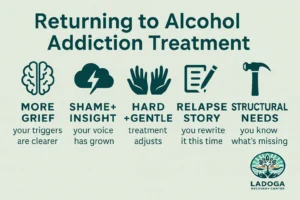
You’ll need to rewrite your “relapse story”
Your relapse story may feel like a scarlet letter. You might believe it marks you as untrustworthy—even to yourself.
But you get to rewrite it. This time, the relapse can be a data point—not the end of your narrative. A mark of struggle, but not proof of defeat. It can be a reason you go deeper, not a reason you stop.
You don’t erase the fact you relapsed. You integrate it. You tell the clinician, the group, your peers: “This is what failed.” “This is what I didn’t see.” “This is what almost killed me.”*
That reclamation is part of the difference: your relapse doesn’t define you. You define your return.
You bring structural needs, not wishes
Before, maybe you walked into treatment hoping structure alone would work—schedule, therapy, group, advice. You hoped “doing the steps” would fix the inside.
This time you know structure won’t be enough unless it’s designed around your vulnerabilities. You’ll need:
- Deeper relapse prevention planning
- Crisis buffers when life shakes (jobs, relationships, guilt)
- Emotional regulation practices, not just “sit still”
- Community and accountability you trust
- Flexibility to adapt when parts of you resist
You’ll test those structures. You’ll demand what’s missing. And you deserve them. The scaffolding that failed you last time must be rebuilt with strength, not faith alone.
You’ll face temptation with more awareness—but also more risk
Returning means temptation will feel sharper. Because you know what alcohol gave you—and how fast your body remembers.
You may start thinking: Just one drink, just one anniversary. You know those rationalizations. You also know how relapse crept in last time. You’ll see the subtle edges where thinking shifts from “I’m safe” to “I deserve one.”
Treatment teams know relapse risk is highest in early reintegration into daily life. (hazeldenbettyford.org) You will need more vigilance, more check-ins, more support than before. Your relapse history means your clinicians should watch you more carefully—not punish you more.
FAQs: Troubles You’re Probably Wondering About
Will they treat me differently because I relapsed?
Sometimes yes—and that’s not always bad. A good clinician will recognize relapse history as a signal—not as permanent failure. They’ll shift assessment, monitoring, empathy, structure accordingly.
Does relapse mean I’m untreatable?
No. Relapse is common. In fact, many people relapse before they succeed at long-term recovery. Treatment is not over because you stepped off. It’s time to step back in—with adjustments.
What should I look for in treatment this time?
Look for environments that welcome your relapse honestly. Ask about relapse protocols, safety plans, emotional support, flexibility. A center that only praises “never relapse” may not hold your return in reality.
How do I build motivation when I feel exhausted and beaten down?
You may not do it from high will power now. Look for small wins. Moments of clarity. Remind yourself why change mattered before. Attach to meaning more than performance.
What if I relapse again?
Plan for that possibility. Build in safety nets, not shame traps. Return immediately. Adjust. Keep going. The only failure is to stay in the lie that one slip erases everything.
You’re not starting over from zero. You’re not less than because you relapsed. You’re more battle-worn, more able to see what needed fixing. You don’t need perfection. You need determination, compassion, better supports, and the courage to re-enter.
You will walk into treatment carrying pride and heartbreak, tools and wounds. That tension is part of your power now. You may test everything. You may feel unsteady. But you may also feel deeper momentum.
If you’re ready to come back with intention, we’re here—no judgment, only invitation.
Call (888) 628‑6202 or visit our alcohol addiction treatment program in Indiana to talk about how we hold relapsers, how treatment can shift, and where your story might turn next.