


I need to start this story honestly, because there’s no point dressing it up:
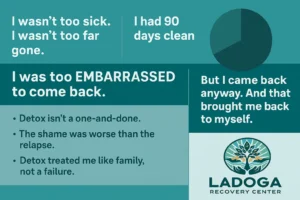
I was too embarrassed to come back.
Not too sick. Not too far gone. Not too “off track.”
Just… too embarrassed.
I had 90 days. Ninety clean, hopeful, steady days. The kind of days I used to dream about when I thought recovery was something other people deserved. And because I had those 90 days, I thought relapse was something I’d never touch again.
But relapse doesn’t ask permission. It doesn’t check your calendar. It doesn’t care how proud you were of yourself.
My slip was small in the beginning. One quiet evening. One drink I thought I could handle. One story I told myself: You’re fine. This is nothing. You’re still sober. You’re still in control.
But that’s the lie that gets you.
Within a week, the old spinning started. Not the chaos—just the shame. The hiding. The pretending. The: Please, God, don’t let anyone notice I’m slipping again.
That shame didn’t just take my sobriety. It tried to take my voice, too. It tried to silence the part of me that knew I needed to return to detox—specifically to the place that helped save my life the first time: Ladoga Recovery Center’s Detox Treatment Programs in Indiana.
But here’s the thing shame didn’t account for:
I came back anyway.
And coming back didn’t break me.
It brought me back to myself.
Yeah, this is my story. But if you’re reading this with a pit in your stomach because you’ve slipped too—this might be your story, too.
The Part Nobody Talks About: The Shame Hits Harder Than the Relapse
People assume relapse is the scary part. The using, the drinking, the waking up wondering how you got there again.
But for me?
The shame was worse.
Shame is sneaky. It doesn’t explode—it erodes. It whispers things like:
- “You already had your shot.”
- “They’ll think you wasted their time.”
- “You’re not one of the success stories anymore.”
- “You’re starting over from zero.”
- “You don’t deserve to come back.”
If you’ve ever tried to re-enter recovery after a slip, you know exactly how loud shame gets. It’s like someone placed a hand around your throat and told you to keep quiet.
And honestly?
I let it win for a while.
I detoxed alone for a couple of days at home, which was dangerous and miserable and not brave at all—just me being afraid to ask for help. Then the withdrawals hit harder. The fear hit harder. And I realized: I’m going to lose everything I gained if I don’t go back for real support.
So I made the call.
And that phone call saved me twice.
The Walk Back In: The Hardest 20 Steps of My Life
I’ve done some scary things in my life.
But walking back into detox after a relapse?
Hardest thing I’ve ever done.
My palms were sweating. My chest felt like a fist. I rehearsed a whole apology speech in my head, as if they were going to make me justify why I needed help again.
I kept expecting someone to say:
“Didn’t we just see you?”
or
“You should’ve known better.”
or
“You already graduated.”
None of that happened.
Instead, the intake nurse said:
“I’m glad you came back.”
Not “Why now?”
Not “What happened?”
Not “Again?”
Just: “I’m glad you came back.”
Those four words were enough to crack my shame right down the middle.
Detox Treatment Programs Aren’t One-and-Done (Even Though We Wish They Were)
My biggest misconception—maybe yours too—is that detox is supposed to be a one-time thing if you’re “doing it right.”
But that’s not how addiction works.
And it’s definitely not how recovery works.
Detox isn’t a graduation.
It’s a stabilizer.
A reset button.
A safe landing when you fall off the edge.
And you know what? A lot of people come back. More than you think. More than they talk about. More than they’ll ever admit out loud—except maybe here, where you need to hear it.
Detox treatment programs exist not because people fail, but because people are human.
Coming Back Didn’t Mean Starting Over—It Meant Starting Honest
The first time I went through detox at Ladoga, I tried so hard to be a model patient. I nodded through group therapy. I shared the “right” amount. I listened. I learned. I held myself together because I wanted to be “the success story.”
The second time?
I didn’t have the energy for that mask.
I showed up cracked open. I cried on day one. I admitted I was terrified. I told them I didn’t know if I could trust myself again.
And still—they welcomed me.
I wasn’t a disappointment.
I wasn’t a burden.
I wasn’t “the one who blew it.”
I was just a person who needed help again.
And honestly? That’s the thing I wish someone told me sooner:
needing help again doesn’t erase the progress you made before.
It just means you’re doing the brave thing twice.
Round Two in Detox Hit Differently—In a Good Way
Something changed in me the second time.
I didn’t rush.
I didn’t fake it.
I didn’t try to perform recovery—I tried to experience it.
And in that slower, more vulnerable space, things landed deeper.
The conversations hit harder.
The support felt more real.
The guidance made more sense.
Maybe because I wasn’t trying to “get it right” this time.
I was trying to get honest.
Detox wasn’t a punishment. It was a pause. A breath. A place to lay down the shame and actually look at myself without running.
Ladoga Didn’t Treat Me Like a Repeat Offender—They Treated Me Like Family
This part matters.
When I returned to Ladoga Recovery Center, nobody acted shocked. Nobody acted disappointed. Nobody asked me to explain myself in some dramatic redemption speech.
They treated me like someone worth saving.
Again.
That open-door, no-judgment welcome?
That’s the opposite of what shame told me to expect.
And that’s why I’m writing this:
Because someone reading this is letting shame call the shots.
Someone thinks they’ve used up their one chance.
Someone thinks they’ll be turned away.
I promise you—you won’t.
FAQs: Coming Back to Detox After a Slip
Will they judge me for relapsing after treatment?
No. Most detox teams expect that relapse may happen. They don’t judge you for needing help again—they expect it, and they know how to support you through it.
Is returning to detox common?
Very. More people return after a slip than you’d ever guess. You’re not unusual, and you’re not alone.
Does a relapse erase my progress?
Not at all. Progress isn’t erased—it’s interrupted. Everything you learned the first time still matters.
What do I even say when I come back?
You don’t have to say anything poetic. “I need help again” is enough. Truly.
Will detox be harder the second time?
Emotionally? Maybe. Physically? It depends on your use. But medically supervised detox keeps you safe both times.
What if I relapse again in the future?
You can always return. Detox isn’t a one-time privilege—it’s an ongoing support option.
What if I’m still ashamed?
Then you’re normal. Courage isn’t the absence of shame—it’s walking in the door anyway.
If You’re Too Embarrassed to Come Back—That’s Exactly Why You Should
The shame doesn’t mean you shouldn’t return.
The shame means you need to.
Shame keeps you sick.
Support helps you heal.
If you slipped, or relapsed, or full-on crashed—you still deserve another chance. The same way I did. The same way countless alumni have.
Let this be your nudge.
Your reminder.
Your permission.
Coming back isn’t weakness.
Coming back is recovery in motion.
If You’re Ready to Try Again, We’re Ready Too
Whether your slip was small or catastrophic, you’re still welcome—fully, completely, without judgment.
Call (888) 628-6202 or visit our Detox Treatment Programs in Ladoga, Indiana to start again with people who understand.
We don’t close the door just because you fell.
We save your seat for when you’re ready to return.