


Let me guess: You’ve got a decent job. A car. Bills paid on time. Maybe you’re even the one your friends or coworkers count on when things fall apart.
And in the middle of all that, you’re using heroin. Quietly. Strategically. Carefully.
You’re not spiraling out of control. You’re managing it.
So when people talk about treatment, you don’t hear yourself in those stories. That’s for people who’ve lost everything. You still get up, show up, and keep it moving.
But if you’ve landed here, I’d invite you to pause and really ask yourself something:
How much of your life is being built around hiding what you’re holding?
Because in my work, I meet a lot of people who are still functioning. Still sharp. Still charming. Still moving. But underneath? They’re exhausted. Disconnected. Running on fumes.
And by the time they sit across from me in treatment, what they usually say is:
“I didn’t know how tired I was until I stopped pretending I wasn’t.”
When “Fine” Is a Performance
High-functioning addiction doesn’t look the way most people expect.
You’re not passed out in a parking lot.
You’re not missing shifts.
Your relationships might be strained, but not destroyed.
You probably even look “healthy” on the outside.
And that’s part of the trap.
Because when you can pass for “fine,” people stop asking questions.
So you stop asking them too.
But here’s what I’ve seen again and again:
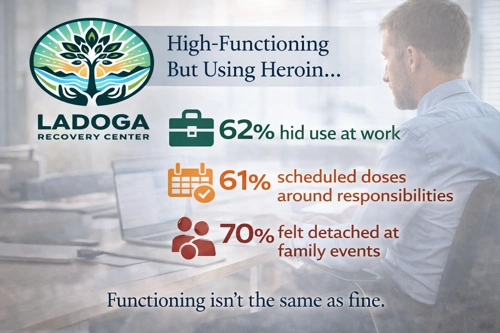
- You’re holding together your work life while using more than you admit
- You’re telling yourself “it’s under control” while planning your next dose around meetings
- You’re present at family events—but not really present
You don’t need to collapse to justify getting help.
You just need to be honest about what your functioning is costing you.
Why High-Functioning People Avoid Treatment
People in your shoes often resist treatment for reasons that sound responsible—but underneath, it’s fear:
“I can’t leave work right now.”
Maybe. But more often, the fear isn’t about work—it’s about being seen.
“I’m not like those people.”
The “those” is doing a lot of work here. Treatment clients don’t all come from crisis. Some walk in in suits. Some log into Zoom from high-level jobs. Some drive Teslas. And yes—some are just like you.
“If I stop, everything might fall apart.”
What if that’s already happening—just slowly enough that you haven’t had to feel it yet?
“I’m managing it. It’s not that bad.”
Until it is. And no one ever says that line on the right day.
Avoidance isn’t strength. It’s fear dressed in logic. And if you’re still reading, you already know that fear has started to wear thin.
The Control Myth
Let’s talk about control.
High-functioning people are usually masters of it.
You control perception.
You control performance.
You control the narrative.
You control your high—how much, when, where, and what people can or can’t see.
But here’s the problem: when you need something to feel normal, you’re no longer in control. The thing is.
It doesn’t matter how carefully you schedule your use. Or how consistent your dosage is.
Dependence doesn’t always look chaotic. Sometimes, it looks like “clockwork.”
The lie is that if no one knows, it doesn’t count.
The truth? The longer you control it on the outside, the messier it becomes on the inside.
You Don’t Have to Lose Everything to Get Help
At Ladoga Recovery Center, we’ve built programs that support people at all stages of addiction—including the ones who haven’t hit bottom, because they’ve been building ladders faster than they fall.
We see high-functioning individuals in:
- Executive roles
- Healthcare and legal professions
- Parents who never miss school pickup
- Students on academic scholarships
- Blue-collar workers pulling doubles
- Quiet caretakers holding families together
They walk in terrified someone will recognize them.
They walk out surprised by how safe it felt to finally drop the performance.
Whether you start with support in Indiana to safely reduce use or with multi-day weekly treatment, you don’t have to give up your life to reclaim it.
What Treatment Actually Looks Like When You’re High-Functioning
We know what you’re picturing: group therapy circles, being forced to “open up,” hearing stories that don’t match your life.
Here’s what treatment can also look like:
- A detox team that helps you stabilize quietly and safely
- A therapist who understands performance addiction
- Groups with people you actually relate to
- A plan that allows you to keep some parts of your schedule intact
- Care designed around boundaries, not emotional exposure
You don’t need a dramatic surrender. You need a space where you can say out loud what you’ve been silently negotiating for years.
That’s what real help in Substance Abuse offers.
You’re Allowed to Be the One Who Needs Help
You don’t have to be the strong one all the time.
You don’t have to carry it all.
You don’t have to be the exception.
And you’re not a hypocrite if you’ve been helping others while secretly struggling yourself.
You’re human.
And maybe it’s finally your turn to be the one who gets help—before everything breaks.
FAQs from People Who “Seem Fine”
Can I get treatment without putting my whole life on pause?
Yes. Programs like structured daytime care or evening outpatient options can support recovery without derailing your responsibilities.
What if no one knows I use? Do I have to tell anyone?
No. Confidentiality is a core part of care. You can begin treatment without disclosing to your employer, family, or friends. You control the narrative.
What if I don’t relate to others in group?
That’s okay. Many high-functioning clients feel this way at first. Over time, shared honesty often bridges differences more than shared circumstances.
Am I overreacting if I haven’t hit a crisis yet?
No. Seeking help before a crisis is called wisdom. It’s the difference between preventative care and emergency care.
What if I don’t know if I’m ready to stop completely?
You don’t have to be. Starting with curiosity is enough. You can begin with harm reduction, exploration, and real conversations—not ultimatums.
You Can Be Both Capable and Struggling
This is what I hope you take away:
You don’t have to earn recovery by falling apart.
You don’t need a dramatic bottom.
You don’t have to wait until the wheels come off.
You’re allowed to want more than white-knuckled survival.
If something in you knows you’ve been operating just above empty…
If something in you wonders what it might feel like to not hide anymore…
Call 888-628-6202 or visit our heroin addiction treatment services in Indiana to learn more.
We’ll meet you with care, not judgment. With clarity, not pressure.
With the kind of treatment that sees behind the mask—and helps you take it off safely.