

You don’t have to feel ready. Just curious enough to ask a question.
For many who are newly diagnosed and considering treatment for opioid addiction, the thought of taking medication feels like a bigger leap than it should. The fears are real: Will it dull my mind? Will I still feel like myself? Am I just trading one substance for another?
If you’re feeling that way—you’re not alone. And you’re not overreacting. At Ladoga Recovery Center, we know the quiet panic that can rise up when someone first hears the phrase medication-assisted treatment. We know what it’s like to question every step of the process, to want help—but only if that help doesn’t erase who you are.
Our approach to opioid addiction treatment in Ladoga, Indiana is centered on your experience, not just your symptoms. We use medication where it makes sense—not to control you, but to support you. So you can find your footing, one choice at a time.
It’s Okay to Be Scared of Medication
Let’s name it—medication can feel scary. Especially when your trust in your body, your mind, or even the system feels shaky. Maybe you’ve had a bad experience with prescription meds in the past. Maybe you’ve been told that “real recovery” means doing it without help. Or maybe you’re just afraid of feeling different.
That fear makes sense. Medication is personal. It’s not just about chemistry—it’s about control, identity, and hope. And when you’re already feeling fragile, adding one more unknown can feel like too much.
But here’s what we’ve learned: the people who are the most careful, the most hesitant, are often the ones who end up doing recovery the most honestly. They’re not rushing in. They’re listening. That’s a strength.
Medication Isn’t About Losing Yourself. It’s About Steadying the Ground Beneath You.
When opioids take over, they don’t just cause physical cravings—they hijack your internal compass. Everything starts to revolve around the next dose, the next moment of relief, the next way to make it through.
Medication like Suboxone or buprenorphine doesn’t erase you. It interrupts the loop long enough for you to get a breath in.
Imagine standing on a ship in the middle of a storm. You’re being pulled in all directions, unable to steady yourself. MAT is like dropping anchor—not to stop your life from moving, but to keep you from being swept away. From that steadier place, you can start to rebuild.
It’s Still Your Choice—Always
One of the most common fears we hear from people is, “What if I lose control?” But here’s the truth—starting medication is often the first time someone feels like they’re regaining control.
When you walk into Ladoga Recovery Center, you won’t be told what to take or how to feel. You’ll be invited into a conversation. You’ll learn about what’s available. You’ll have time to think, ask questions, and figure out what’s right for you.
There is no one-size-fits-all in our opioid addiction treatment program. If medication is the right fit for you, great. If you want to start with therapy and revisit the idea later—that’s fine too. You get to decide what support looks like. That’s the foundation of our care.
“But What If I Feel Numb?” — Addressing the Fear of Being Changed
Many people fear that medication will change their personality or dull their creativity, energy, or emotional range. Especially if you’re someone who’s always been passionate, expressive, or emotionally deep, the idea of feeling “flat” can be terrifying.
What we see instead is often the opposite.
When withdrawal symptoms subside and the body isn’t fighting itself anymore, there’s room for clarity. You may feel emotions more fully—not less. You may reconnect with parts of yourself that were buried under survival mode.
And if at any point the medication feels off, we’ll work with you to adjust. It’s not about numbing you. It’s about stabilizing you enough to be yourself again—on your own terms.
You Don’t Have to Be 100% Sure to Begin
We often hear people say, “I don’t know if I’m ready.” That’s okay. Readiness is a spectrum—not a light switch. You don’t need total confidence to walk through our doors. Just enough curiosity to ask, “What would help me feel better today?”
There’s no commitment required to have a conversation. You can learn about the medications we offer. Ask what side effects are possible. Talk about what’s worked for others. Share your fears—out loud.
And if today isn’t the day to start treatment, that’s okay too. We’ll still be here tomorrow.
You’re Not the Only One Asking These Questions
Every week, we sit with people asking the same things you might be wondering right now:
“Is this just substituting one addiction for another?”
No. Medications used in MAT are carefully prescribed, monitored, and adjusted. They don’t produce the same high—and they’re designed to support stability, not create dependency.
“How long will I have to take this?”
That’s up to you and your provider. Some people use medication short-term. Others find it helpful for longer. You’re not locked into any timeline.
“What if people judge me for being on Suboxone?”
We get it—stigma still exists. But it’s not welcome here. At Ladoga, we see MAT as a legitimate and evidence-based path to recovery. Anyone who says otherwise isn’t looking at the full picture.
Real Words from People Who’ve Been There
“I was scared it would make me feel like a zombie. But after the first week, I just felt…calm. Like I could finally hear myself think again.”
— Client, 2024
“I didn’t want medication at first. Now, I’m six months in, working full-time, seeing my kids again. I still feel like me. Just a version that sleeps through the night.”
— Client, 2023
Recovery Isn’t One-Size-Fits-All—And Neither Is Medication
Some people start with medication and taper off. Others find long-term support works best. And some try it, decide it’s not right, and build their recovery another way. All of these are valid.
What matters most is that you’re supported while you figure it out. That you’re given options—not ultimatums.
At Ladoga Recovery Center, we believe recovery isn’t about following rules—it’s about finding rhythm. We’ll help you find yours.
Ready to Talk About Medication—Without Pressure?
Whether you’re newly diagnosed, feeling unsure, or just need someone to talk through the what-ifs with, our team is here. Quiet fear deserves gentle answers. And every recovery story starts with one conversation that felt safe enough to have.
Learn more about opioid addiction treatment in Ladoga, Indiana and the medication options we offer—or just give us a call. You don’t have to decide everything today. Just take the next step that feels right.
Frequently Asked Questions About Medication and Opioid Addiction Treatment
What is MAT and how does it help?
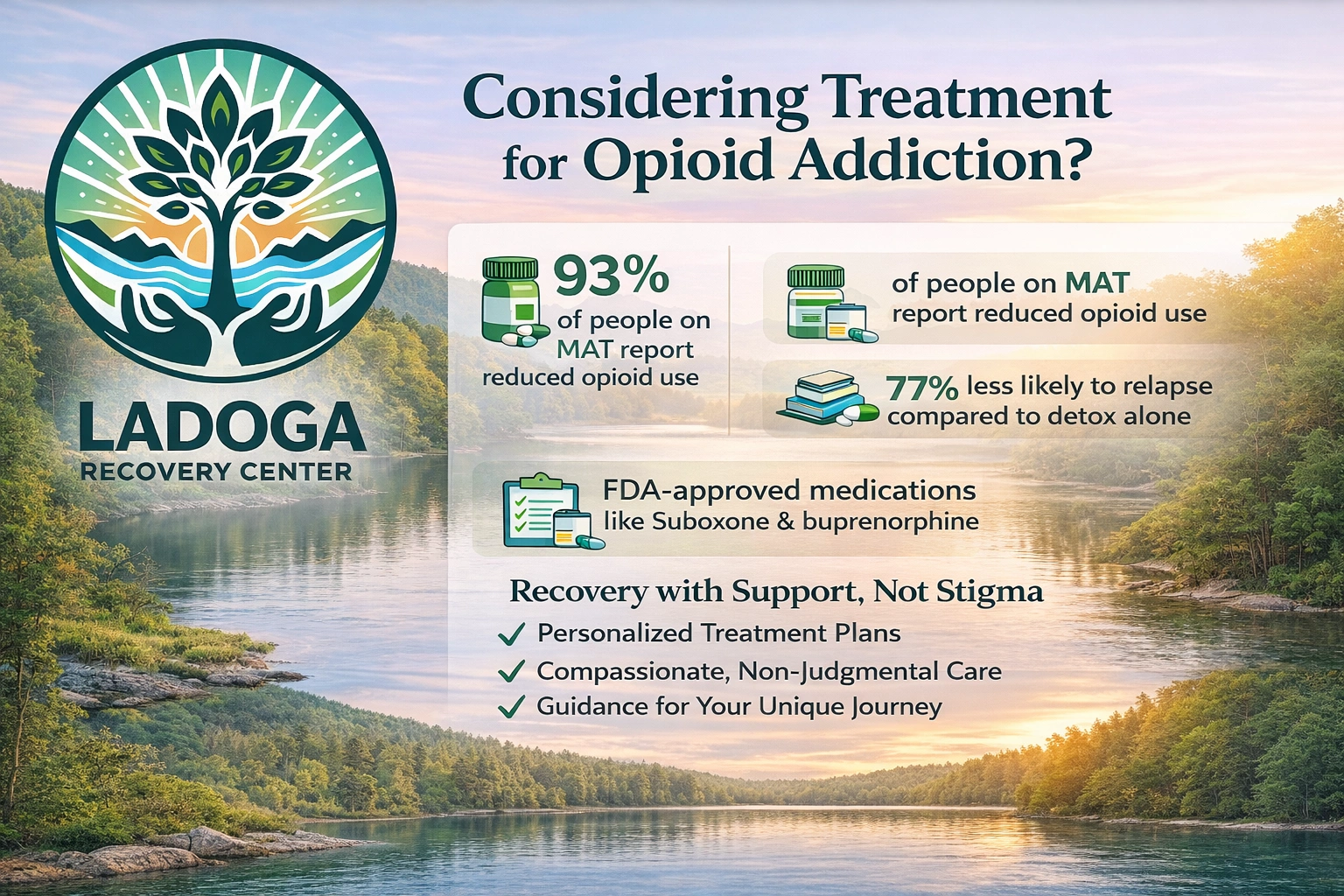
MAT stands for Medication-Assisted Treatment. It uses FDA-approved medications like Suboxone or methadone alongside therapy to reduce cravings, prevent withdrawal, and support long-term recovery. It’s not a replacement for healing—it’s a foundation to make healing possible.
Is MAT just trading one drug for another?
No. While opioids hijack the brain’s reward system, MAT medications work differently. They stabilize brain chemistry without producing a high, helping people focus on rebuilding their lives—rather than chasing relief.
Will I feel high or sedated on medication?
Not when taken as prescribed. These medications are designed to reduce the rollercoaster of highs and crashes. Most clients describe the effect as “even,” “clear,” or “normal.”
Can I stop taking MAT if I want to?
Yes. You and your care team will work together to decide when (or if) tapering makes sense. There’s no set timeline—and no pressure.
Will I still be able to feel emotions?
Absolutely. In fact, many people find they’re more emotionally present once withdrawal symptoms and cravings are no longer in control. Any emotional flattening is discussed and addressed if it arises.
How do I know if medication is right for me?
That’s something we’ll explore together. You’ll learn about the options, hear real stories, ask your questions, and get to decide based on what feels safe and supportive—not what someone else thinks you should do.
Take the First Step Toward Healing
Call (888) 628-6202 to learn more about our opioid addiction treatment services in Ladoga, Indiana.
You deserve answers. You deserve support. You deserve to feel like you again.