


You’re not falling apart.
You’re showing up to work. You’re managing your schedule. People still trust you. You’re reliable. You’re productive. You handle your business. And when things get hard? You don’t crumble. You get resourceful.
So it’s easy to believe you’re okay.
Because what kind of person checks into a residential treatment program when they haven’t lost everything?
You’d be surprised.
High-Functioning Doesn’t Mean Healthy
At Ladoga Recovery Center, we see people like you every week.
People who run companies, lead teams, raise families, care for aging parents. People with spotless reputations and carefully curated routines. They don’t “look like addicts.” They’ve never been arrested. They haven’t been fired. They’re not sleeping on a friend’s couch.
But they are unraveling.
Not all at once. Slowly. Quietly. Behind closed doors.
We call it internal collapse. It’s not the kind of crash that lands you in an ER—it’s the kind that shows up in your relationships, your patience, your sleep, your mood, your shame.
And it’s often hidden by something you’ve learned to weaponize: competence.
The Hidden Cost of Keeping It Together
If this hits too close to home, take a breath.
You’re not weak for managing well. But you are likely exhausted.
You’ve trained yourself to push through the hangover. To pour a drink and call it “winding down.” To justify your pills because “everyone’s stressed.” To perform well enough that no one asks the questions you’re quietly afraid of.
But there’s a cost.
When your entire identity is built on keeping it together, you never get to put it down. You live in fear of being found out—not because you’re doing something illegal, but because you’re doing something unsustainable.
And if you’re honest, you’re starting to feel it.
The short fuse. The mental fog. The fear of what you’d feel without something to take the edge off.
Addiction doesn’t always kick the door in. Sometimes, it lets you stay on your feet just long enough to not notice how much you’ve already lost.
You Don’t Have to Lose Everything to Need Help
One of the biggest myths that keeps high-functioning adults from getting support is the idea that you have to hit some dramatic “rock bottom” before you qualify for treatment.
Here’s the truth: You don’t need to wait until your life is on fire to decide it’s time to step out of the smoke.
If your use is affecting your peace, your relationships, your clarity, your sense of self—that’s enough.
It doesn’t matter how well you’re performing on the outside. If the inside feels like chaos, something needs to change.
And a residential treatment program isn’t about “fixing” you—it’s about giving you space to rest, recalibrate, and recover in ways you can’t while still carrying your full-time life on your back.
What Residential Treatment Looks Like for High-Functioning Adults
Let’s get something straight: this isn’t about stripping away your identity or throwing you into a rigid, one-size-fits-all program.
At Ladoga, our residential treatment program is structured, professional, and respectful of your complexity.
You won’t be babied. You won’t be judged. And you definitely won’t be treated like a worst-case scenario.
You’ll be:
- Given space to slow down—without losing momentum in life.
- Surrounded by clinicians who understand high achievers.
- Provided with evidence-based therapies that actually align with your personality and pace.
- Supported in developing strategies that work not just in rehab, but in your real world.
This isn’t “dropping out of life.” This is an intentional pause so you can return with more clarity, integrity, and freedom than you’ve had in years.
Control vs. Dependency: A Hard Truth
Most high-functioning clients don’t describe themselves as addicted. They describe themselves as managing. Coping. Unwinding. Dealing with stress.
But here’s a litmus test worth sitting with:
- Can you go a full week without your substance of choice—and feel mentally clear?
- Do you plan your use so it doesn’t interfere with responsibilities—or so you can get through them?
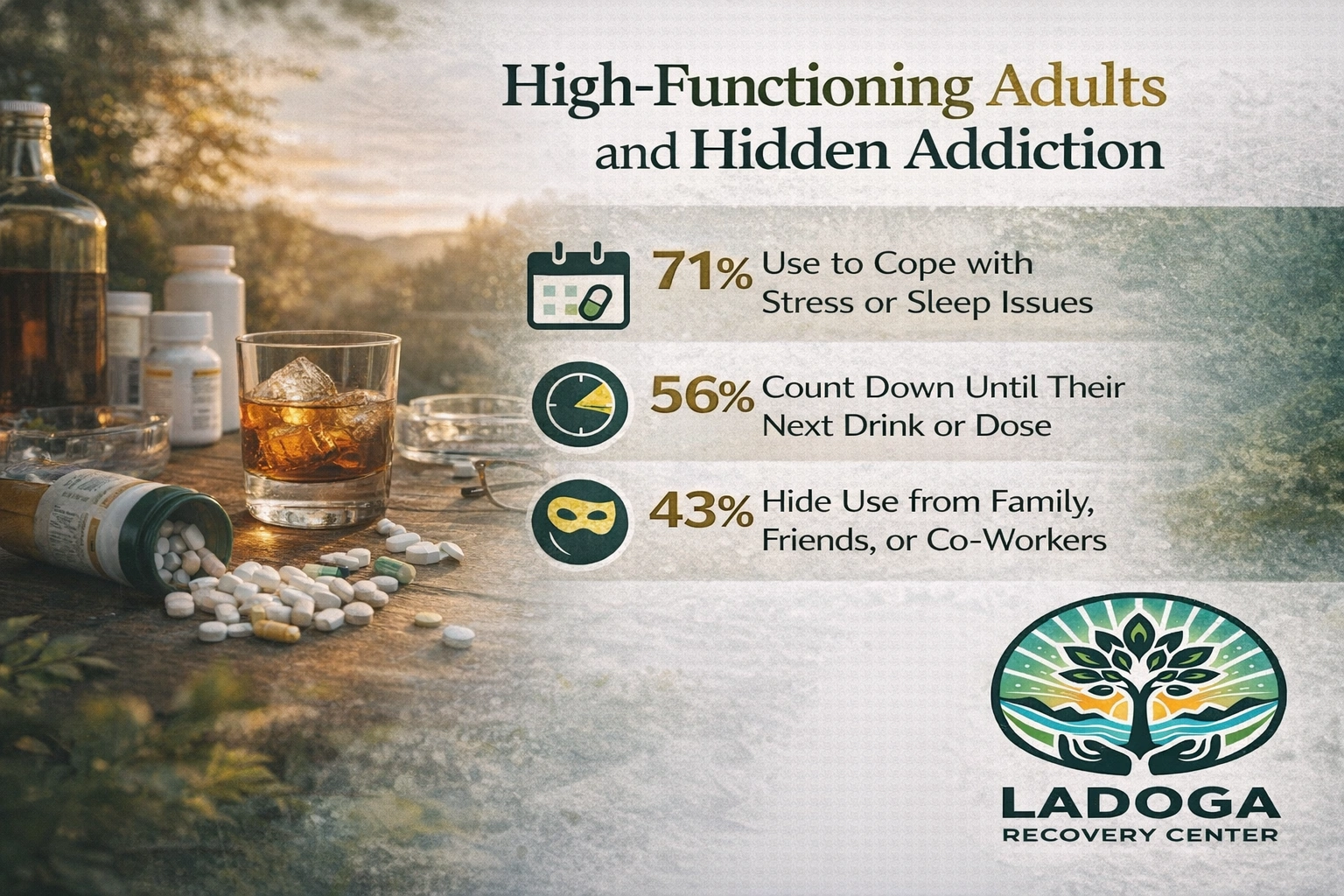
- Do you ever lie about how much you’re using, even in small ways?
- Have you made rules (no drinks before 5, only on weekends, only after the kids are asleep)—and broken them?
- Do you feel uneasy imagining life without it?
If you’re checking these boxes, you’re not in control. You’re in a managed relationship with dependence—and it’s taking up more of your life than you realize.
Strategic Retreat Is a Power Move, Not a Collapse
Walking away from your responsibilities to enter treatment might feel impossible.
But let’s flip the script.
What if taking 30 days for deep healing is the smartest investment you could make?
What if you could return to work and family more clear-headed, more connected, and more yourself?
What if healing isn’t weakness—but the strongest, boldest move you make this year?
High-functioning doesn’t have to mean high-cost. And no one deserves to live in quiet desperation just because they still meet deadlines.
There Are Private, Professional Treatment Options in Indiana
Ladoga offers treatment options in Indiana that are private, supportive, and designed for professionals and adults who need real support—not hand-holding or scare tactics.
We work with people who want a reset—not a rescue.
Whether you’re navigating alcohol, stimulants, benzos, or a quiet-but-powerful emotional spiral, our team meets you with dignity, not assumptions.
You don’t need to explain your résumé to deserve help. You just need to let someone in.
Quick Check: Signs You Might Be Quietly Struggling
You might be managing on the surface, but consider this:
- You’re drinking or using “just to sleep” more nights than not
- You feel disconnected even during “happy” moments
- Your mornings feel harder than they should
- You catch yourself watching the clock—waiting for that next glass, pill, puff
- You think about stopping, but you’re afraid of who you’d be without it
If any of these resonate, that’s not weakness. That’s awareness. And awareness is the first step toward freedom.
FAQs About Residential Treatment for High-Functioning Adults
Will I lose my job if I go to residential treatment?
You may have protections under the Family and Medical Leave Act (FMLA), which allows for up to 12 weeks of leave for medical reasons—including substance use treatment. Many professionals take a temporary leave discreetly, with full support from their HR departments. We can help you navigate this process confidentially.
Do I have to share my story in a group setting?
No. While group therapy is a powerful tool, we never force disclosure. Many of our clients start with individual therapy and ease into groups when it feels right. You’ll never be pressured to share before you’re ready.
What if I need to work during treatment?
We understand that some roles require flexibility. While we encourage a true break, we also offer case-by-case accommodations for executive clients who need limited work access. Our goal is to create the best environment for healing—while respecting your professional reality.
You don’t have to wait for the walls to fall down.
Call (888) 628-6202 to learn more about our Residential treatment program in Indianapolis, Indiana.