

How to Turn Sober Curiosity Into a Real First Step Toward Treatment | Alcohol Addiction Treatment

How to Turn Sober Curiosity Into a Real First Step Toward Treatment Alcohol Addiction Treatment

You’ve heard the whispers in your head:

“Maybe I’d feel better tomorrow if I skipped the wine.”
“I’m not sure I even know what life without drinking might feel like.”
“Is treatment only for people like that… not me?”

That curious, restless space you’re in? It’s powerful. It’s the breathing room where real change often begins. You might not be ready to declare it. You might not even want to admit it—to anyone, including yourself.

But part of you is wondering. And that’s enough.

At Ladoga Recovery Center, we’ve walked alongside many sober-curious clients—people who didn’t see themselves as “alcoholics,” but who unexpectedly found clarity, hope, and peace when they invited someone to help them explore.

Whether this is your first time thinking maybe, or you’ve been circling this idea for months—this guide is your quiet encouragement. Let’s walk you through how to make that curiosity into a real, supportive first step toward alcohol addiction treatment in Indiana, on your terms.

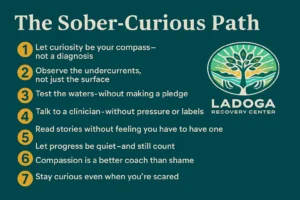
1. Let Curiosity Be Your Compass—not a Diagnosis

You don’t need to name it. Not yet.
You just need to notice.

Curiosity isn’t the same as commitment. It’s closer to asking, “What if I didn’t have to wonder anymore?”

That curious voice might ask:

  • “What’s behind this impulse to drink?”
  • “What am I avoiding?”
  • “What if I feel… nothing, instead of everything?”

The only wrong question is thinking you have to have the “right” one.

If you can sit with your uncertainty—brave enough to ask, “Could this go deeper?”—you’re on the right path.

2. Observe the Undercurrents, Not Just the Surface

It’s easy to ignore alcohol’s role when life still looks “fine.” But patterns hide in quiet places:

  • The thought you push away when you feel stressed or bored.
  • The toast you plan for the moment the week ends.
  • The line between “I’ll just have one” and losing track.

These aren’t failures. They’re subtle signals.

Tracking those undercurrents—without punishment—is not about proving something. It’s about gathering clues.

Because even small shifts in awareness change everything.

3. Test the Waters—Without Making a Pledge

You don’t have to dive into full treatment right away. You can wade in with intention.

Pick a week—just one—and be curious about what changes when alcohol isn’t in the mix.

  • Does your sleep deepen or become lighter?
  • Do you notice memories shifting in tone?
  • How do you cope with downtime now?
  • What sigh of relief greets your morning?

No goal. No long-term plan. Just honest observation.

When one client did that, they discovered something unexpected:
“I didn’t lose joy—I lost hangovers.”

That alone felt like progress.
Sober Curiosity Path

4. Talk to a Clinician—Without Pressure or Labels

Many people shy away from treatment because it sounds like deciding everything in the first call.

But it doesn’t have to be that way.

When you reach out to Ladoga Recovery Center, you’re simply asking questions—not making a lifelong commitment.

  • You can talk to someone who’s not going to judge
  • You can ask what treatment options look like—residential, outpatient, evening therapy, etc.
  • You can see if it fits your life rhythm and values

You don’t owe them a label. You just owe yourself the chance to know.

5. Read Stories Without Feeling You Have to Have One

High-functioning doctors, nurses, teachers, entrepreneurs—many of our clients didn’t start in crisis.

They started with a nagging doubt, a jitter in the first sip, a craving they couldn’t name.

If that story resonates, know that’s more common than you think.

One former client, a long-time educator, said —
“I didn’t want to be part of ‘the problem people.’ I just wanted to stop dragging behind myself.”

That’s enough of a reason to keep reading.

6. Let Progress Be Quiet—And Still Count

You might not be ready for sobriety today. That’s okay.

Maybe your curiosity looks like:

  • Knowing when you’ve hit your limit with one or two.
  • Starting to choose spaces that support clarity—social or mental.
  • Rejecting “just one more” becomes easier.

These aren’t failures waiting to be judged. They’re gradual shifts. They’re cracks forming in the old script—and that’s where light can get in.

7. Compassion Is a Better Coach Than Shame

It’s easy to say, “I should be stronger.” Or, “I did it before, so why not now?”

But shame and pressure can push you deeper into hiding.

Kindness invites you to ask:

  • “What am I protecting by not exploring this?”
  • “What would life feel like without the need to numb?”

You don’t need to dismantle yourself. You just need permission to be curious—with someone who cares.

8. Stay Curious Even When You’re Scared

Fear is a normal companion on this path. It might show up as:

  • Fear of losing social connection
  • Fear of losing identity or coping
  • Fear that quitting will be boring—or impossible

But sometimes fear is just unmet curiosity in disguise. Asking, “What if I lose who I am?” is also asking, “Who else could I still be?”

Treatment can help you explore that question—carefully, respectfully, at your pace.

FAQ: Moving from Sober Curiosity Toward Real Treatment

I’m not sure I need help. Is that OK?

Absolutely. You don’t need a diagnosis to deserve clarity or support.

What does treatment look like if I’m sober curious?

It could be a few check-ins, short-term outpatient, group support, therapy, or just learning tools to explore boundaries.

Can I really do this without giving up everything?

Yes. Many people start with gentle outpatient work and keep their lives intact.

I’m afraid people will judge me. How private is treatment?

Confidentiality is core to treatment at Ladoga. Your privacy, schedule, identity—they all matter.

Will I lose my social life?

Not if you’re clear about your needs. It will shift. But it may become richer, not smaller.

What Comes Next—Only You Can Say

If you’re still reading this, you’ve already taken the bravest step: permissioning liking your life but wondering if it could feel lighter, clearer, more real.

Treatment isn’t failure. It’s clarity. Not the kind of label you stick on your chest—more like removing a fog so you can see yourself again.

At Ladoga Recovery Center, we’re here to help sober curiosity become discovery, at your pace, with respect, with options.

Call (888) 628-6202 or visit our Alcohol Addiction Treatment page for support that starts by listening—not judging.Your curiosity matters. Let’s explore what it might lead to—together.
*The stories shared in this blog are meant to illustrate personal experiences and offer hope. Unless otherwise stated, any first-person narratives are fictional or blended accounts of others’ personal experiences. Everyone’s journey is unique, and this post does not replace medical advice or guarantee outcomes. Please speak with a licensed provider for help.

Tim Grzeskiewicz was raised in the Washington, DC Metro area and completed High School in Fairfax County Virginia before entering the United States Marine Corps where he achieved the rank of Seargent before being honorably discharged. Tim has worked several careers over the years, with his move into mental health and addictions being his final transition, which he refers to as his “move from success to significance”. Tim completed his undergraduate studies at Indiana University, graduating with honors and attending Huntington University for graduate school. Tim’s passion for the addictions population comes from his own experience with substance use issues and is currently a sober man in recovery with over 27 years of sobriety. Tim’s hope is to lead others in love and service to the sick and suffering.

With over 25 years of experience in healthcare and more than a decade dedicated to nursing practice, Mandy brings a wealth of knowledge, leadership, and compassion to her role as Director of Nursing at Ladoga Recovery. She earned her Bachelor of Science in Nursing from Indiana University Northwest and has built a career spanning diverse clinical settings, developing expertise in patient-centered care, clinical operations, and team development.

Mandy’s dedication to the field of addiction recovery is not only professional but also deeply personal. Having walked alongside loved ones in the throes of addiction, she understands firsthand the challenges, heartache, and hope that come with the journey of recovery. This perspective drives her passion to ensure that every patient is treated with dignity, empathy, and respect.

Specializing in substance use treatment and recovery support, Mandy is committed to fostering an environment where patients receive safe, evidence-based care during one of the most critical times in their lives. Her leadership style emphasizes collaboration, staff education, and adherence to best-practice protocols to ensure the highest quality of care.

Passionate about guiding both patients and staff toward growth and resilience, Mandy continues to be an advocate for recovery-focused healthcare that not only supports healing but also transforms lives.

Ethan brings over six years of hands-on-experience in the substance abuse and mental health field, where he has built a career rooted in passion, resilience, and a deep commitment to helping other transform their live. Starting from an entry-level role and working his way up through the ranks, he’s gained a strong understanding of the challenges individuals face in recovery – both clinically and personally. 

His journey in the SUD field has been fueled by a genuine passion for supporting individuals as they confront addiction and mental health struggles. He takes pride in meeting people where they are, creating a safe and supportive environment, and helping them recognize their own potential. Whether through patient facing positions or leadership roles, he has strived to show every individual that recovery is not only possible but within reach. 

Throughout his career, he’s been recognized for his ability to lead with integrity, build trust, and foster growth – not only in the clients he’s served but also in the team’s he’s worked with as well. Ethan believes in leading by example, staying grounded in empathy, and always advocating for those who may not yet have the strength to advocate for themselves. Helping other discover their own path to recovery is more than a job to him, it’s a calling. Every step forward that he witnesses in someone else’s life journey reaffirms why he does this work and will be committed to this mission for years to come.

Cristina Monnett

Cristina Monnett is an HR professional with over 12 years of experience supporting teams in manufacturing and healthcare. She partners closely with operations leaders in fast-paced, highly regulated environments to strengthen employee relations, ensure compliance, and implement practical, real-world people strategies. Cristina is passionate about creating workplaces where employees feel supported and organizations run smoothly.

Shane Austin is a dedicated behavioral health professional, bringing a wealth of experience in the field of substance use disorder treatment. As a lifelong resident of Indiana and an alumnus of the Indiana University, Shane embodies a profound sense of empathy and understanding, deeply rooted in his own transformative four-year journey of recovery. This personal experience fuels his passion and relentless commitment to inspiring individuals to embrace the treatment that leads to lasting sobriety and fulfilling lives. By connecting those in need with essential resources, Shane skillfully utilizes his knowledge and personal narrative to illuminate the path to recovery for others, empowering them to embark on their own successful journeys.

Dr. William Cooke is the Medical Director of Ladoga Recovery Center, an inpatient facility dedicated to providing comprehensive and compassionate care for individuals struggling with substance use disorders. With over two decades of experience in addiction medicine, Dr. Cooke leads the clinical team at Ladoga Recovery Center with a focus on evidence-based practices and patient-centered care.

As a board-certified expert in both Family Medicine and Addiction Medicine, Dr. Cooke brings a holistic approach to treatment, integrating medical, psychological, and social support to address the complex needs of individuals on their journey to recovery. Under his leadership, Ladoga Recovery Center emphasizes a “whole-person” philosophy, ensuring that each patient receives tailored treatment plans that foster long-term recovery and overall well-being.

Dr. Cooke is also a Fellow of the American Society of Addiction Medicine (ASAM), reflecting his commitment to advancing the field of addiction medicine through continuous learning, advocacy, and collaboration. At Ladoga Recovery Center, he is dedicated to creating a safe, supportive, and effective environment where patients can begin their path to healing.

As Executive Director of Ladoga Recovery Center, Brian Foster brings nearly a decade of experience in behavioral health, specializing in substance use disorder and co-occurring mental health treatment. With a diverse background spanning from inpatient detox and residential care, sober living, outpatient treatment, and both the for-profit and nonprofit sectors, Brian is dedicated to creating comprehensive, holistic treatment programs. Holding a Business degree from Indiana University and graduate degree from Indiana Wesleyan University, Brian combines a strong foundation in business with a personal commitment to recovery, using his own experience to inspire and support others on their journeys. This broad background enables Brian to approach leadership with a well-rounded perspective on the complex needs of individuals in Recovery.

As a person in long-term Recovery, Brian is proud to lead a team that makes a meaningful impact on the lives of those struggling with addiction and helping them rebuild relationships with their loved ones. Living in Fishers, IN, with a supportive wife and two wonderful daughters, family is the heart of Brian’s life, bringing a deep commitment to building a community where individuals can find hope, healing, and a path forward.