


You walked away once. Maybe your phone went unanswered. Maybe the meetings felt too heavy. Maybe life outside treatment pulled you back in.
Now you’re here again—wanting out, wanting clean, but terrified of the tunnel being lonely.
You don’t have to detox alone. You deserve more than isolation. You deserve a plan, a team, care, safety.
This is your guide. A map back—not into the forest—but toward the light with support.
At Ladoga Recovery Center, our drug detox program isn’t a cold cage. It’s a shelter. You will not walk through this storm yourself.
1. Recognize That Detox Is a Medical Process, Not a Test of Willpower
One of the most dangerous lies you might tell yourself is, “I can do this on my own.”
Withdrawal is not weakness. It’s biochemical upheaval.
When you stop using, your brain, heart, kidneys, nervous system—all demand readjustment. That can mean seizures, heart rate spikes, hallucinations, intense anxiety, vomiting, dehydration.
A supervised detox program monitors your vital signs, provides medications where appropriate, and ensures your body doesn’t spiral into crisis. Doing it alone without those safeguards is like navigating a minefield blindfolded.
So yes, the first safe step is admitting you need support.
2. Get an Honest Medical Assessment Before You Start
Before detox begins, you should do a deep health check. This is not just paperwork. It’s crucial triage.
Your intake assessment should cover:
- What substances, how long, how much
- Any history of seizures, liver disease, cardiac issues
- Co‑occurring mental health conditions (depression, anxiety, PTSD)
- Any current medications you take
- Baseline labs, ECG, kidney/liver panels
One of the questions many dropouts wonder: “If I restart detox, will it be harder?”
Possibly—but a proper assessment lowers that risk by customizing the plan to your physical and psychiatric profile.
3. Admit the Need for Supervised Detox (It’s Not Defeat)
This is hard: to return, to say you need help. But that admission is strength.
A supervised detox program offers:
- 24/7 medical staff
- Symptom management medications
- Quiet, controlled environment
- Emotional support around the clock
- Monitoring to catch complications early
You will not be left alone with your body screaming. You will have someone to hold the space, to steady your nerves, to treat you like a person—not a “problem.”
4. Choose Who You Let Into This Space—and How Much
You may not be ready to let everyone in. But letting someone in is necessary. Isolation is the path relapse takes.
Pick 1–2 trusted people who:
- Understand your relapse history
- Won’t shame you
- Can assist with logistics (rides, child care, job coverage)
- Can hold space on your bad days
You can ask them to check in, sit in the waiting room, help remind you to drink water, or simply text you during a rough patch. Having someone tethered to you means less danger of disappearing.
One thing I learned: you don’t need the whole world in that room. You need a few anchors.
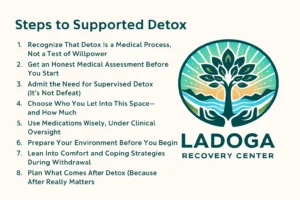
5. Use Medications Wisely, Under Clinical Oversight
Medications are not a crutch—they’re a tool. When used properly, they ease the worst of withdrawal and let your brain catch up.
Possible supports include:
- Medication‑assisted treatments (opioid detox meds, etc.)
- Symptom relief drugs (antiemetics, muscle relaxers, sleep aids)
- Controlled tapering protocols
One common worry: “If I use medication, I’ll just be substituting one addiction for another.”
The truth: given under supervision, medications are measured, controlled, and part of a detox blueprint—not a handover to a new addiction.
6. Prepare Your Environment Before You Begin
Detoxing your environment is as important as detoxing your body.
Before you enter detox:
- Remove or lock up all substances (alcohol, pills, paraphernalia)
- Clear your schedule—don’t schedule appointments, work shifts, stressors
- Inform your support people you’ll be harder to reach
- Pre‑stock healthy food and water
- Set up a restful, low‑stimulation space
If your environment remains chaotic, your brain will fight harder to resist. You don’t just need internal safety—you need external boundaries.
7. Lean Into Comfort and Coping Strategies During Withdrawal
Withdrawal is brutal. But you can carry it with less damage if you have coping tools.
Try these:
- Deep breathing, grounding practices
- Gentle movement: stretching, short walks
- Distraction tools: music, art, writing, puzzles
- Calm rituals: warm showers, soft blankets, quiet reading
- Hydration and gentle nutrition—small sips and easy foods
You will not outrun discomfort. But with tools, you can slow it, hold space for it, breathe through it.
When you feel like screaming: reach instead of retracting. Call someone. Press a call light. Ask for help. You don’t have to brave the storm in silence.
8. Plan What Comes After Detox (Because After Really Matters)
Detox is the opening act, not the grand finale. Without planning what comes next, detox can feel like a reset without a plan—and that’s a relapse risk.
Your care team should help you map out:
- Immediate next‑step: residential, outpatient, IOP
- Therapy schedules
- Peer support (meetings, recovery groups)
- Medical/psychiatric follow‑ups
- Safe housing, if needed
“After” is where the work lives. If your detox ends and you walk back into chaos, the gains crumble. Don’t let it.
Questions You’re Likely Asking (And Should)
You’re already wary. You’ve been ghosted by your own hope before. So you want answers you can trust.
Will detox still work if I’ve relapsed multiple times?
Yes. Sometimes your body and brain respond better after a reset with clinical care. You’re not beyond help.
Is detox going to destroy my job, finances, relationships?
Potentially short disruption. But good programs help mitigate that: confidentiality, paperwork, reduced lapses, phased return.
What if I can’t make detox last all the way through?
That doesn’t mean failure. You pause, you ask for support, you re-enter. The goal is connection, not perfection.
Do I have to tell everyone I’m detoxing?
No. You control who knows. But one or two people can make a difference in keeping you sober. You don’t have to carry it with silence.
Does detox guarantee I won’t relapse again?
No. Detox gives your brain and body space—but relapse can still happen. What changes is your foundation: stronger, safer, guided.
Detox is not just stopping—it’s starting. Starting your body’s recovery. Your brain’s repair. Your life’s reorientation.
You don’t have to detox alone. You deserve medical care, listening ears, steady hands, plans, boundaries, and compassion.
If you’re ready, the path is there—and you don’t have to walk it alone.
Call (888) 628‑6202 or visit our drug detox page to begin a safer detox—together.