


You may feel invisible in this moment. The person you love is going through something dangerous, painful, and intense—and your own heart is trembling. You want to help. You want to hold them up, but you also want to survive this.
If your partner is entering or already in drug detox, you’re part of this story. Here’s a guide—drawn from experience and care—for how you can support them, protect yourself, and believe in healing. And if you ever want to see how professional detox works here in Michigan, we have a program at Ladoga Recovery Center.
What does real support look like during detox?
Support doesn’t mean solving. It means presence.
During detox, your partner is wrestling with withdrawal, fear, shame, and silence. What helps more than anything is someone who believes in them—even when they don’t believe in themselves.
Real support may include:
- Listening without trying to fix
- Saying “I’m here” more often than giving advice
- Making small gestures (a note slipped in, a text of encouragement)
- Keeping promises you make, no matter how small
I once heard someone say: “Just because detox can feel lonely, doesn’t mean you have to be lonely.” That stuck. Your presence—even quiet—can shift everything.
Should I talk? Or stay quiet?
That question feels huge. Because sometimes silence is safety—and sometimes your voice is needed. The key is timing, tone, and intention.
If visits or calls are allowed:
- Keep messages simple: “Thinking of you,” “You’re not alone,” “I believe in you.”
- Avoid guilt or emotional load (“I’m dying here,” “I’m worried sick”)
- Let them set the pace. If they pull away, don’t push through your pain
If contact is limited or paused:
- Accept that their mind needs space. It isn’t a punishment to you.
- Try writing a letter they may read later
- Hold that your love doesn’t disappear just because your voice is silent
One partner shared: “I told them I wouldn’t demand responses—just leave the door open with my heart.” That kind of calm can do more than speeches in moments of overwhelm.
What boundaries are safe—and necessary?
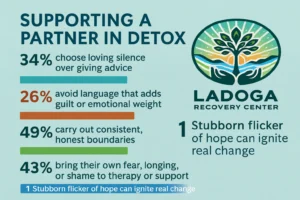
Love doesn’t mean no limits. Detox is a vulnerable time. Boundaries protect your heart and support your partner’s process.
Consider boundaries like:
- Emotional load limits: Decide how much weight you can carry today
- Communication rules: “I won’t respond to guilt trips or ultimatums.”
- Space/time limits: You can be present without losing yourself
- Self-care insistence: You need breaks, safe people to talk to, rest
One partner told me: “I gave them love, and I gave myself permission not to drown.” That balance is not luxury—it’s survival.
How do I cope with the fear, shame, and longing?
Being in love with someone using, detoxing, or recovering is a constant tension: hope and terror walking hand in hand. Your emotions are valid.
Here are ways to care for yourself:
- Reach out for your own support: therapy, support groups, trusted friends
- Keep a journal (even if it’s messy) so you release what you can’t say
- Allow yourself “bad days”—they don’t mean you failed
- Do small steady acts of care: a walk, music, art, presence with nature
One spouse said, “I’m learning to breathe for two—my partner, and me.” You don’t have to carry their burden. You only have to carry your part.
How do I bring hope into this, gently?
Hope isn’t naive. It’s choosing belief over despair—every day.
Ways to bring hope:
- Remind them of their strength, not their failure
- Tell small stories of others who came through detox and recovery
- Ask clinicians if you can hear debriefs or small updates (without demanding)
- Revisit the promise you made to yourself to stay steady
A friend once told me: “I whispered to them: ‘You’ve gotten this far. You can keep going.’” Sometimes hope is quiet. But it echoes.
Are there real stories I can lean on?
Yes. We don’t often hear them—so I’ll share just a few:
- Case of J & M: J detoxed twice before walking out on day 3 each time. The third time, M (their partner) stopped calling, started sending one-line check-ins in the morning, and showed up at just the right moments. J stayed through that attempt—and in recovery now.
- Case of S & A: S was silent the first four days. A wrote small notes and arranged for a private visitation on the fifth day. That visit turned things for S. They both say that simple presence helped S settle into possibilities again.
- Case of R & E: E detoxed with family sessions scheduled. R was allowed to attend one and learn how to support—not control. That shift, from parent-like role to partner role, was critical in E’s decision to lean into treatment longer.
These stories don’t erase pain. They show possibility. You cannot manufacture outcomes—but you can be part of the shift.
Will detox make them different forever?
Detox is a doorway—not a full transformation. It clears the chemical noise so therapy, growth, and repair can begin. They may shift, yes—but so may your relationship too.
What if they relapse after detox?
It can happen. Detox isn’t the end. But your love, boundaries, and continued care can be a stabilizing force in later stages. Relapse often teaches what needs more repair—don’t let it erode your hope completely.
Can I attend parts of detox or therapy with them?
Often, yes—depending on the program’s values. Ask the facility. Invite family or partner sessions. But don’t demand inclusion—sometimes trust needs to be earned from both sides.
How do I avoid burning out in the process?
You protect your boundaries. You get your support. You rest. You tell someone what’s happening. You remember you’re human, too—not a support machine.
If they push me away, does that mean I failed?
No. Detox is stormy. Sometimes people retract, close up, or go inward. It doesn’t necessarily reflect your love or caring. It’s part of the process. Stay ready. Stay kind. Reconnect when it’s safer.
When detox ends—what then?
Detox is the first step. After they’re physically stable, the real journey begins. Your role shifts.
After detox:
- They may move into residential or outpatient treatment
- You may be invited into therapy or family work
- You’ll learn new boundaries and roles
- You’ll need continued support too—don’t disappear
You don’t get a “finish line” in detox—but you get a foundation to rebuild. And your presence on the other side matters, every bit as much as your presence during.
You’re not a counselor. You’re not supposed to fix this. You are love, amid uncertainty. You can show up imperfectly, stay with the pain, set boundaries, and keep believing.
Your partner is in a moment of immense struggle. But in that struggle, someone loves them so much they stayed—because you are not only part of their story—you can also be part of their healing.
If you want help learning how detox works, how to show up in healthy ways, or what support you need—call (888) 628‑6202 or visit our drug detox program in Ladoga, Indiana. We support both the person detoxing—and the one loving them through it.