


Ninety days.
For a while, that number felt like a new identity.
Ninety days sober.
Ninety days of rebuilding trust.
Ninety days of answering texts instead of avoiding them.
Ninety days of waking up without immediately calculating what I had said, done, or forgotten the night before.
I remember looking at that number and thinking I had crossed some invisible finish line.
Not that recovery was over.
Just that the hardest part was behind me.
Then one night, I relapsed.
The next morning wasn’t dramatic.
No police.
No ambulance.
No major catastrophe.
Just me staring at the ceiling, feeling a kind of disappointment that seemed to press down on my chest.
I kept asking myself the same question:
“How did I end up back here?”
If you’ve relapsed after a period of sobriety, especially after several months of doing well, you may know exactly what that question feels like.
The shame arrives quickly.
The self-criticism arrives even faster.
And somewhere underneath both is a desperate desire to make the problem disappear.
That’s where I found myself.
I wasn’t looking for recovery.
I was looking for a shortcut back to feeling okay.
Instead, I learned that the thing I needed most was the thing I wanted least:
More support.
That realization eventually led me to learn more about residential treatment in Indiana, and looking back, it may have been one of the most important decisions I ever made.
I Wanted to Fix Everything Before Anyone Found Out
The first few days after relapse felt like living with a secret.
I didn’t want to tell anyone.
Not my friends.
Not the people who supported me.
Not the people who celebrated my sobriety.
I certainly didn’t want to admit it to myself.
Instead, I immediately started searching for ways to erase what happened.
Maybe I could attend a few extra meetings.
Maybe I could get more disciplined.
Maybe I could simply promise myself it would never happen again.
The goal wasn’t understanding the relapse.
The goal was avoiding the embarrassment of it.
Looking back, that’s what kept me stuck.
I treated relapse like a stain I needed to cover instead of a signal I needed to understand.
The Relapse Started Long Before I Used
This was one of the hardest truths to accept.
For weeks before I relapsed, things had been changing.
I was isolating more.
I was becoming less honest about how stressed I felt.
I stopped reaching out when I struggled.
I convinced myself I didn’t need as much support anymore.
On the surface, everything looked fine.
Internally, it wasn’t.
What I’ve learned since then is that relapse rarely begins with the substance itself.
It often begins with disconnection.
Disconnection from support.
Disconnection from accountability.
Disconnection from honesty.
The substance use simply becomes the final chapter of a story that has been unfolding for a while.
Recognizing that changed how I viewed my relapse.
Instead of seeing a single mistake, I began seeing a pattern that needed attention.
I Thought More Treatment Meant I Had Failed
For a long time, I believed something that many alumni believe after relapse.
If I needed more care, it meant I wasn’t trying hard enough.
I viewed higher levels of support as something reserved for people who were struggling more than I was.
People with bigger consequences.
People with longer relapses.
People who were somehow worse off.
This mindset kept me trapped.
I wasn’t evaluating what I needed.
I was evaluating whether I deserved help.
Those are very different questions.
The moment I started asking, “What gives me the best chance of staying sober?” instead of “How bad am I?” everything began to shift.
The Hidden Cost of Wanting a Quick Fix
At first, a quick fix sounded appealing.
Who wouldn’t want one?
I wanted to return to normal immediately.
I wanted the shame gone.
I wanted people to trust me again.
I wanted my confidence back.
What I didn’t realize was that my obsession with a quick fix came with a cost.
The more focused I became on feeling better quickly, the less focused I became on understanding why I relapsed.
I wanted relief.
Not insight.
I wanted comfort.
Not change.
But recovery doesn’t grow in the same soil as avoidance.
Eventually, I had to slow down long enough to ask difficult questions.
What was I running from?
What had changed?
What support had I stopped using?
Those questions were uncomfortable.
They were also necessary.
The Comparison Trap Nearly Kept Me Stuck
One thing I hear from alumni all the time is:
“My situation isn’t that bad.”
I said the same thing.
I compared myself to people whose stories seemed more severe.
Their relapse lasted longer.
Their consequences looked worse.
Their lives appeared more chaotic.
Because of those comparisons, I convinced myself I didn’t need additional help.
The problem with comparison is that it doesn’t measure risk.
It measures pride.
Recovery decisions shouldn’t be based on whether someone else has it worse.
They should be based on what you need right now.
Once I understood that, I became more open to exploring options that previously felt unnecessary.
The Question That Changed Everything
A counselor asked me something I still think about today.
“If your current level of support was enough, would you be having this conversation?”
I didn’t have an answer.
Because deep down, I knew the answer already.
What I had been doing wasn’t working anymore.
That didn’t mean treatment failed.
It didn’t mean recovery failed.
It simply meant I needed something different.
That realization felt surprisingly emotional.
Part of me was relieved.
Another part was terrified.
Accepting more support meant accepting reality.
And reality was harder to avoid than relapse itself.
I Learned Environment Matters More Than Willpower
For years, I believed recovery was primarily about determination.
If I wanted sobriety badly enough, I could make it happen.
While motivation matters, it’s not the whole story.
Environment matters too.
The people around you matter.
Structure matters.
Accountability matters.
Daily routines matter.
Many people researching inpatient vs outpatient addiction treatment after a relapse are really trying to answer a deeper question:
“Do I need more structure than I currently have?”
That was the question I eventually faced.
And once I answered honestly, the path forward became clearer.
I realized I wasn’t weak because I needed more support.
I was being realistic.
The Shame Lost Power When I Stopped Hiding
One thing surprised me after I became honest.
The shame didn’t disappear immediately.
But it became smaller.
Every conversation reduced it.
Every supportive response reduced it.
Every reminder that relapse is survivable reduced it.
Shame thrives in silence.
It feeds on secrecy.
It grows when we believe nobody will understand.
The moment I stopped hiding, shame started losing its leverage.
That doesn’t mean vulnerability was easy.
It wasn’t.
But it was worth it.
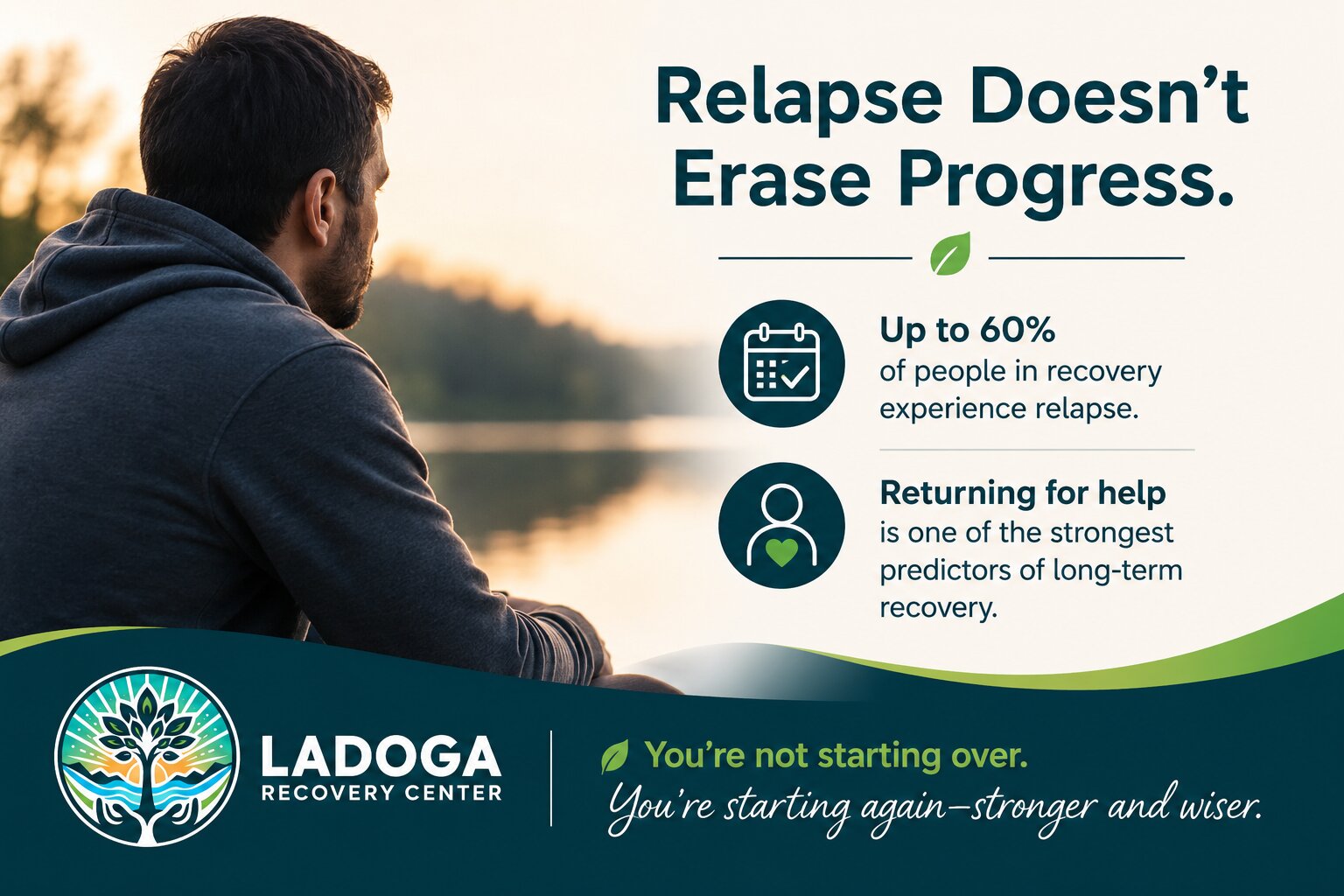
Recovery Didn’t Reset to Zero
This may be the most important thing I learned.
After relapse, I felt like I was back at day one.
Emotionally, it certainly felt that way.
But recovery isn’t a video game where progress disappears after one mistake.
Those ninety days still mattered.
The lessons still mattered.
The growth still mattered.
The relationships I repaired still mattered.
Everything I learned came with me.
I wasn’t starting over.
I was starting again.
And those are not the same thing.
Starting over assumes nothing remains.
Starting again recognizes that experience still has value.
That distinction gave me hope when I needed it most.
The People Who Return Are Often Braver Than They Realize
I’ve met many alumni who returned after relapse.
Almost every one of them arrived carrying shame.
Almost every one of them feared judgment.
Almost every one of them believed they had somehow failed.
What I’ve seen instead is courage.
Returning takes courage.
Being honest takes courage.
Walking back through a door you hoped you’d never need again takes courage.
The people who come back aren’t weak.
They’re people who refuse to stop fighting for themselves.
And that matters.
Frequently Asked Questions
Is relapse after 90 days common?
Relapse can occur at any stage of recovery. While ninety days is a meaningful milestone, it does not make someone immune to stress, triggers, or setbacks.
Does relapse mean treatment failed?
No. Relapse often provides valuable information about what additional support, structure, or recovery tools may be needed moving forward.
How do I know if I need a higher level of care?
If previous recovery strategies are no longer working, cravings are increasing, or maintaining sobriety feels significantly more difficult, it may be worth discussing additional support options with a professional.
Is returning to treatment a sign of weakness?
Not at all. Many people who achieve long-term recovery required multiple treatment experiences throughout their journey.
What if I feel ashamed about asking for help again?
Shame is common after relapse, but it should not prevent you from seeking support. Many people discover that honesty reduces shame more effectively than hiding it.
How is starting again different from starting over?
Starting again means bringing your previous experience, growth, and knowledge into the next phase of recovery. A relapse does not erase everything you learned before it happened.
Can recovery still happen after relapse?
Absolutely. Many individuals who now enjoy long-term sobriety experienced one or more relapses before finding lasting recovery.
You Are Allowed to Need More
If you’ve relapsed and find yourself searching for a quick solution, I understand.
I did the same thing.
But sometimes the fastest way forward is not the quickest fix.
Sometimes it’s accepting the level of support you actually need.
Needing more help does not erase your progress.
Needing more structure does not make you weak.
Needing a different approach does not mean recovery is out of reach.
It simply means you’re still fighting for your future.
And that’s something worth respecting.
Call (888) 628-6202 or visit our levels of care for addiction treatment in Indiana and residential treatment in Indiana services to learn more about our levels of care for addiction treatment in Indiana, residential treatment services in Indiana.