


Finding an unfamiliar substance in your home, your teenager’s backpack, your partner’s car, or a loved one’s belongings can be frightening. Your mind may immediately jump to the worst-case scenario, especially if you’ve noticed changes in their behavior or health.
If you’re searching what does meth look like, you’re probably hoping for clear answers—not assumptions or judgment.
The truth is that methamphetamine can appear in several different forms, and appearance alone cannot confirm what a substance is. Many legal medications and other illicit drugs can look remarkably similar. The safest approach is to avoid touching or testing an unknown substance yourself while focusing on protecting your loved one and getting professional guidance.
If methamphetamine use has become a concern, early intervention can make a meaningful difference. Professional meth addiction treatment can help individuals safely begin recovery while addressing the physical, emotional, and behavioral effects of stimulant addiction.
At Ladoga Recovery Center, we help individuals and families throughout Ladoga, Crawfordsville, Indianapolis, and surrounding Indiana communities find compassionate, evidence-based care.
What Methamphetamine Typically Looks Like
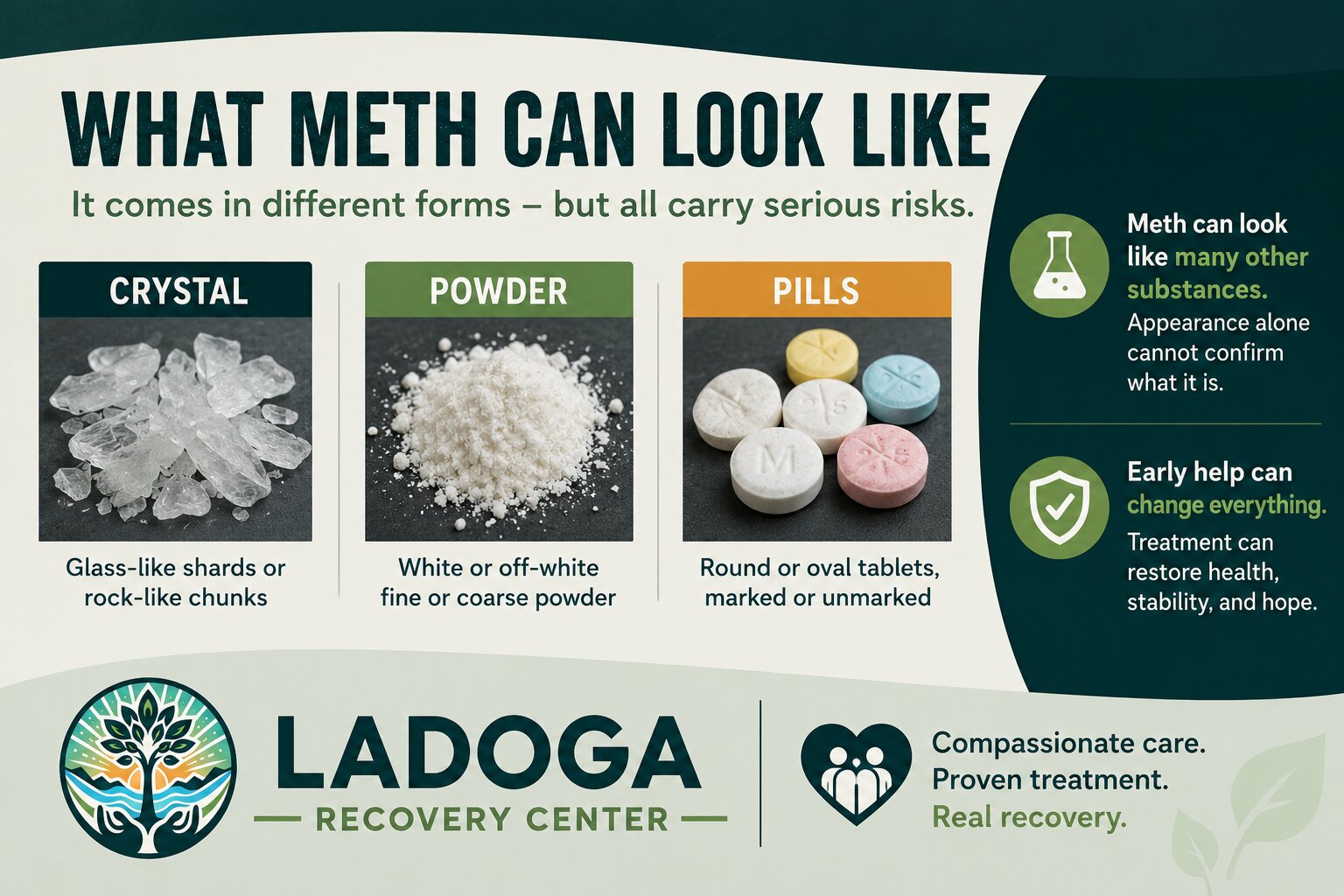
Methamphetamine is manufactured illegally in several forms. While the drug’s appearance can vary depending on how it was produced, there are three forms people are most likely to encounter:
- Crystal meth
- Powder meth
- Pill or tablet forms
Each looks different, and none can be identified with certainty based on appearance alone.
Crystal Meth
Crystal meth is the form many people recognize from photographs or television.
It often appears as:
- Glass-like shards
- Jagged crystals
- Rock-like chunks
- Small translucent fragments
The pieces may resemble broken glass, coarse rock salt, or crushed ice.
Crystal meth is often associated with higher purity than powdered forms, but appearance alone does not indicate strength or purity.
Powder Meth
Methamphetamine may also appear as a loose powder.
It can resemble:
- White powder
- Off-white powder
- Slightly yellow powder
- Fine or coarse powder
Because powdered meth can look similar to cocaine, crushed medications, baking soda, or other household substances, it is impossible to identify simply by looking at it.
Pill or Tablet Forms
Methamphetamine sometimes appears in pill form.
These tablets may be:
- White
- Off-white
- Colored
- Round
- Oval
- Marked with letters or numbers
- Completely unmarked
Some pills sold as methamphetamine may actually contain other stimulants or entirely different substances. Likewise, counterfeit pills may contain methamphetamine without the buyer realizing it.
Never assume a pill is safe simply because it resembles a prescription medication.
Colors and Common Variations
One of the biggest misconceptions is that meth is always bright blue because of its portrayal in popular culture.
In reality, illegal methamphetamine can vary considerably in appearance.
Crystal Variations
Crystal meth may appear:
- Clear
- Colorless
- White
- Blue-white
- Yellowish
- Slightly pink
- Brownish
Color differences often reflect impurities, manufacturing methods, or contaminants rather than quality.
Powder Variations
Powdered meth may be:
- Bright white
- Off-white
- Beige
- Yellow
- Grayish
The texture may range from very fine to somewhat gritty.
Pill Variations
Pressed tablets may vary in:
- Size
- Shape
- Color
- Imprints
- Logos
Counterfeit pills are increasingly common, making visual identification unreliable.
How Each Form Is Commonly Used
Different forms of methamphetamine may be used in different ways, although no method is safer than another.
Crystal Meth
Crystal meth is commonly:
- Smoked
- Injected after dissolving
- Occasionally swallowed
Smoking often produces rapid effects because the drug reaches the bloodstream quickly through the lungs.
Powder Meth
Powder meth may be:
- Snorted
- Dissolved and injected
- Swallowed
- Sometimes smoked
How quickly effects begin depends on the method of use.
Pills
Tablets are generally swallowed but may also be crushed for snorting or other forms of misuse.
Regardless of the form, methamphetamine carries significant risks, including addiction, cardiovascular complications, mental health changes, and overdose.
How to Tell Meth Apart from Other Substances
Unfortunately, you usually cannot.
Many substances closely resemble methamphetamine, including:
- Rock candy
- Bath salts
- Crushed prescription medications
- Table salt
- Sugar crystals
- Epsom salt
- Cocaine
- Ketamine
- Baking soda
- Laundry additives
- Various research chemicals
Similarly, pills sold illegally may contain methamphetamine, fentanyl, MDMA, or other substances that are impossible to distinguish visually.
For that reason:
- Do not taste an unknown substance.
- Do not smell it closely.
- Do not perform internet “identification tests.”
- Do not rely on color alone.
- Do not assume appearance predicts safety.
Only laboratory testing can determine exactly what a substance contains.
Other Signs That May Suggest Methamphetamine Use
Finding an unknown substance is only one piece of the picture.
Families often notice behavioral or physical changes before discovering the drug itself.
Possible warning signs include:
Physical Changes
- Significant weight loss
- Decreased appetite
- Dilated pupils
- Difficulty sleeping
- Increased energy
- Repetitive movements
- Poor dental health over time
- Skin sores from repetitive picking
Behavioral Changes
- Unusual secrecy
- Mood swings
- Increased irritability
- Anxiety
- Restlessness
- Staying awake for extended periods
- Financial problems
- Neglecting responsibilities
- Social withdrawal
These symptoms can have many different causes and do not automatically mean someone is using methamphetamine.
Items That May Be Found Nearby
Sometimes families discover unfamiliar objects before they ever find the substance itself.
Drug paraphernalia may include:
- Small plastic baggies
- Glass pipes
- Burned foil
- Straws
- Rolled paper
- Small digital scales
- Torch lighters
- Syringes
- Burn marks on household items
None of these items alone confirms methamphetamine use, but finding several together may warrant a conversation and professional assessment.
When Identifying Meth Means It Is Time to Get Help
Many families hesitate because they are afraid of accusing someone unfairly.
Others continue hoping the situation will improve on its own.
If you have discovered an unknown substance alongside concerning behavioral changes, it may be time to seek guidance—even if you are not completely certain what you found.
Professional addiction specialists can help determine:
- Whether substance use is likely involved
- Whether a clinical assessment is appropriate
- What level of treatment may help
- How families can respond effectively
- How to approach difficult conversations
You do not have to solve the situation alone.
What to Do If You Find a Suspected Substance
Finding something that may be methamphetamine can trigger panic, anger, or fear.
Instead, try to focus on safety.
Do Not Handle It Unnecessarily
Avoid touching, tasting, or smelling an unknown substance.
If you must move it, consider using disposable gloves and keep it away from children and pets.
Avoid Immediate Confrontation
Finding a substance often creates an emotional moment.
Whenever possible, wait until everyone is calm before starting a conversation.
Accusations made in anger often lead to defensiveness rather than honesty.
Watch for Signs of a Medical Emergency
Call 911 immediately if the person experiences:
- Chest pain
- Difficulty breathing
- Seizures
- Loss of consciousness
- Severe agitation that creates immediate danger
- Hallucinations accompanied by violent behavior
- Extremely high body temperature
- Collapse or inability to wake up
These symptoms require emergency medical attention regardless of the substance involved.
Reach Out for Professional Help
Even if you are unsure what you found, an addiction professional can help you understand your concerns, discuss next steps, and connect your loved one with appropriate care.
Early treatment often prevents problems from becoming more severe.
Treatment for Meth Addiction in Indiana
Methamphetamine addiction affects far more than physical health. It can impact relationships, employment, finances, mental health, and nearly every aspect of daily life.
Recovery often involves more than simply stopping drug use. Comprehensive treatment may include:
- Individual counseling
- Group therapy
- Family therapy
- Cognitive behavioral therapy (CBT)
- Treatment for co-occurring mental health conditions
- Relapse prevention planning
- Ongoing recovery support
At Ladoga Recovery Center, we provide compassionate, individualized care for people throughout Ladoga, Crawfordsville, Indianapolis, and surrounding Indiana communities. Every treatment plan is tailored to the person’s unique needs, helping them build the skills and support necessary for long-term recovery.
You Don’t Have to Figure This Out Alone
Discovering what you believe may be methamphetamine can be overwhelming. Whether you’re worried about a child, spouse, sibling, or friend, remember that appearance alone cannot confirm what a substance is—but it can be an important sign that it’s time to seek help.
If your loved one’s substance use has become a growing concern, early intervention can make a significant difference.
Call (844) 628-6202 today to speak with the admissions team at Ladoga Recovery Center or learn more about our meth addiction treatment programs serving individuals and families throughout Indiana.
Frequently Asked Questions
Is meth always blue?
No. While blue meth has become well known through popular culture, methamphetamine is more commonly clear, white, off-white, or slightly yellow. Color varies depending on manufacturing methods and impurities.
Can you identify meth just by looking at it?
No. Many legal and illegal substances look similar to methamphetamine. Only laboratory testing can confirm what an unknown substance contains.
What does crystal meth look like?
Crystal meth often appears as clear or whitish glass-like shards, rock-like chunks, or coarse crystals that resemble broken glass or crushed ice.
What should I do if I find suspected meth?
Avoid tasting, smelling, or closely handling the substance. Keep it away from children and pets, avoid confronting your loved one in anger, and seek guidance from an addiction professional. If someone shows signs of a medical emergency, call 911 immediately.