
There’s a fear that sits quietly underneath a lot of hesitation about treatment—especially for people who’ve built their identity around creativity, connection, intensity, or expression.
It’s not just the fear of withdrawal, or the stigma of the word “addict.”
It’s the fear of disappearing.
“What if sobriety takes away the spark?”
“What if treatment dulls the edge I rely on?”
“What if I get sober… and I don’t recognize myself anymore?”
At Ladoga Recovery Center’s opioid addiction treatment program, we meet this fear with deep respect. Because we know what’s often underneath it: not resistance, but protection. You’re not resisting recovery. You’re trying to protect the parts of yourself that still feel meaningful.
That’s not selfish or wrong.
That’s human.
You’re Not Here to Become Someone New — Just to Reconnect with What’s Already Yours
People often think of addiction treatment as a full personality transplant. A reinvention. A before-and-after montage.
But recovery, at its best, isn’t about becoming someone new.
It’s about reclaiming who you were before substances got in the way.
You don’t need to erase your identity to recover. You don’t need to trade your depth, your weirdness, your heart, or your history for a sterile version of health. You just need space to untangle who you are from what’s been trying to keep you afloat.
And we can help you do that—gently, honestly, without rushing the process.
Opioids May Have Helped You Feel Something—Until They Started Numbing Everything
If you’ve been using opioids for a while, it’s probably because they worked… until they didn’t.
Maybe they helped you manage pain—physical or emotional. Maybe they made it easier to create, to perform, to quiet the inner critic long enough to actually do the thing. Maybe they softened the edges of a loud brain or a loud world.
That makes sense. We won’t pretend otherwise.
But over time, the very thing that once made you feel more alive can start to mute the world instead. Instead of writing, you’re sleeping. Instead of connecting, you’re retreating. Instead of feeling everything, you feel… nothing.
What opioids gave you at first wasn’t fake. But it also wasn’t the only way to access emotion, flow, or connection. And once they stop giving, it’s okay to want something more than survival.
The Fear of “Losing Yourself” in Treatment Is Often a Sign You Still Know Who You Are
Here’s something we wish more people understood:
If you’re afraid of losing yourself, that means you still know there’s a self worth keeping.
That’s not something to be afraid of. That’s something we can work with.
At Ladoga Recovery Center, we see you as more than your use. We see the you that’s still in there—the one who feels too much, who writes songs at 2am, who’s carried the weight of family expectations or trauma or neurodivergence with a quiet kind of grit.
We don’t want to scrub that away.
We want to help you access it again.
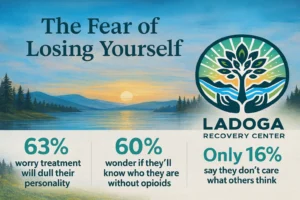
Recovery Isn’t a Flattening. It’s a Reawakening.
Let’s name it: the fear of being boring after sobriety is real.
Especially for people who are expressive, emotional, or high-energy. It can feel like substances are what unlock the color, the story, the punchline, the poem.
But we’ve worked with enough creative people in recovery to know: you don’t lose the color. You just learn to paint with it in new ways.
Instead of writing from a place of chaos, you write from clarity.
Instead of performing through pain, you perform from presence.
Instead of using substances to feel enough, you feel—because you finally have the capacity to.
It’s not always linear. But it’s real. And it’s possible.
Treatment at Ladoga Is Tailored—Not Templated
One of the reasons people fear recovery is because they picture a rigid, clinical environment where everyone’s expected to heal the same way.
That’s not how we do things here.
Our opioid addiction treatment services in Indiana are personalized, trauma-informed, and built to support the whole person—not just their symptoms.
We offer a range of approaches, including:
- Individual therapy for deep emotional work
- Group therapy for connection and shared truth
- Medication-Assisted Treatment (MAT) when appropriate, to reduce cravings and support stability
- Creative therapies and expressive outlets
- Psychoeducation to help you understand your brain, not just control it
You won’t be forced into a one-size-fits-all mold. Your story matters. So does your style of healing.
You’re Allowed to Miss What It Gave You—And Still Want Something Better
There’s a quiet grief that comes with recovery. It’s okay to name it.
You might miss the rush. The ease. The rituals. Even the community around using.
That doesn’t mean you’re failing. It means you’re honest.
In treatment, we make space for that grief. We don’t shame it or rush it. Because the truth is, you can miss parts of what opioids gave you and still want to move toward something different.
Recovery isn’t about denying your past. It’s about deciding your future gets a vote, too.
When You’re Ready, We’re Here
You don’t need to feel fully ready. You just need to feel done enough with how things are.
That’s often where change begins—not with perfect certainty, but with a tired kind of hope.
When that moment comes, know this: you’re not too complicated. You’re not too late. You’re not too “high-functioning” or “artsy” or “damaged” to be helped.
You’re just human. And we can work with that.
Frequently Asked Questions About Opioid Addiction Treatment
Will opioid addiction treatment make me feel numb or flat?
It’s a common fear—especially for people who’ve relied on substances to access emotion or creativity. But most people in recovery report the opposite. Over time, they feel more connected, emotional, and present—not less.
What if I don’t want to do a 12-step program?
That’s okay. While 12-step groups help some people, they’re not the only path. At Ladoga, we offer multiple approaches to healing—including options that honor autonomy, creativity, and individual values.
Is Medication-Assisted Treatment (MAT) just replacing one drug with another?
Not at all. MAT uses FDA-approved medications to reduce cravings and stabilize brain chemistry. When paired with therapy and support, it can be life-saving—not limiting. And it’s always optional and tailored to your needs.
Can I still be myself in treatment? Will I be forced to change my personality?
You don’t have to change who you are—you just get to heal what’s hurting. Your creativity, your identity, your weirdness, your humor? Those are welcome here. We want to protect your essence, not erase it.
How do I know if I actually need treatment?
If you’re asking this question, you probably already feel something’s off. You don’t have to hit rock bottom to get help. If opioids are taking more than they’re giving—emotionally, physically, or creatively—that’s reason enough to reach out.
Is treatment in Ladoga, Indiana private and confidential?
Yes. Your privacy is protected under state and federal laws, including HIPAA. Whether you’re local or coming from out of town, your confidentiality matters—and we take it seriously.
How do I get started?
Just one step: Call us. We’ll walk you through the rest. No pressure, no judgment. Just a real conversation about what’s going on and what support could look like.
Ready to Talk?
You don’t have to erase yourself to get better. You just need a space where you can show up as you are—and be seen, supported, and reconnected with what matters most.
Call (888) 628-6202 or visit our opioid addiction treatment page to learn more about how we support recovery in Ladoga, Indiana.
Because the real you? They’re not gone.
They’re waiting.
And we’d be honored to help you find your way back.