


I thought relapse would be the chapter I couldn’t recover from.
After 90 days, I walked out feeling ready, hardened, redeemed. Then the old voices crept back. The cravings. The shame. The “just this once.”
When I relapsed, I felt like I erased everything.
But in returning to drug detox at Ladoga Recovery Center, I discovered that relapse doesn’t have to be your ending. It can be the pivot. The sharp turn you didn’t see coming, but that becomes the way forward.
Relapse Isn’t a Shame Stamp—It’s Part of the Road
If you’re reading this, you know the guilt drip. The fear that you broke the trust irrevocably. The idea that people will see you as weak—or worse, as “back to square one.”
Let me say this: relapse doesn’t void your progress. It doesn’t cancel your mornings sober, your meetings attended, your self‑care you practiced. Those things never fully disappear. They matter. You matter.
Your relapse is a crack in the mask, not the mask’s destruction. It forces you to see what was hidden, what you left unsettled, what needs more than just surface repair.
Why Returning to Detox Can Be the Best Decision You Ever Make
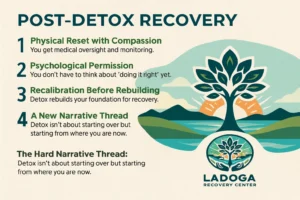
1. Physical Reset with Compassion
You don’t need to slog through detox alone or unsafe again. Going back means you get medical oversight, monitoring, symptomatic relief, hydration, nutritional support—all the elements you skipped or rushed the first time.
2. Psychological Permission
Detox gives you a break from the internal wars. It says: “Your brain and body deserve time to repair before we rebuild.” You don’t have to think about “doing it right” yet. You just have to arrive.
3. Recalibration Before Rebuilding
When relapse hits, often your thought patterns, coping tools, boundaries—all of them—are destabilized. Detox is the reset button. It rebuilds your foundation so future recovery has traction, not shaky footing.
4. A New Narrative Thread
You’re not coming in fresh. You bring your history, lessons, scars, wisdom. Detox this time becomes part of a new arc—not starting over, but starting from where you are now, with more awareness.
What Happens in Detox When You Return
Walking back into detox isn’t unfamiliar ground, but it’s different this time.
- Medical supervision so your withdrawal doesn’t spiral uncontrolled.
- Medication-assisted support if your body requests it.
- Emotional support—talks, check-ins, people who’ve been where you are.
- Transition planning into the next level: therapy, rehab, outpatient, peer support.
- Respect and dignity—no judgment for relapse, only for choosing to come back.
You’re not a “relapse case.” You’re a person showing up again.
“I Thought I’d Permanently Lost Progress” — Voices from Alumni
One man said he felt he reset to day one. But at the end of detox, he told his counselor: “I lost my way—but I didn’t lose my story.”
Another woman, after 120 days relapse, confessed she believed she had zero worth. But when she entered detox a second time, she was met with people saying: “We expected you might be back. We’ve held space.” That acceptance helped break her shame loop.
You are not the first to come back. You will not be the last.
The Hard Parts Are Still There—But So Are the Tools
Time doesn’t erase your vulnerability. But detox gives you the time to remember your tools—or build new ones.
You’ll feel cravings. You’ll feel frustration. You’ll feel guilt.
Yes, you might despair one night again. But you will also speak a new line: “I deserve support, not judgment.”
Detox doesn’t remove the pain. It gives you enough margin to see light beyond it again.
Detox Followed by Growth: What Comes Next
Leaving detox doesn’t mean returning to chaos. It means stepping into treatment that builds on the reset:
- Therapy to unpack triggers, patterns, trauma
- Group support to connect with others who relapsed too
- Aftercare planning—outpatient, sober living, peer groups
- Relapse prevention strategies freshened for where you are now
- Ongoing medical and psychiatric care
This time, your treatment isn’t just a program. It’s a dialogue: You bring your relapse story; the staff meets you with strategy, compassion, consistency.
Changing the Frame: From Failure to Turning Point
You thought slipping meant you were weak. But it might mean you were strong—strong enough to challenge your limits again. Strong enough to realize some parts still needed repair.
This relapse can become your turning point if you let it teach rather than punish. If you allow detox to be a reset, not a reset of shame—but a reset of strategy.
Your recovery is not erased by relapse. It’s interrupted—and many times, those interruptions lead to breakthroughs you couldn’t achieve otherwise.
FAQ: Questions You’re Quietly Asking Yourself
Q: Will detox after relapse even work?
Yes. Your body still responds. With medical care, many relapse-returners have smoother detox and faster stabilization because their bodies “know” the terrain.
Q: Won’t people judge me for relapsing?
They might. But at a good facility, staff and fellow residents will expect relapse. They won’t shame you. You’ll often find kindness from people who’ve relapsed themselves.
Q: Does relapse mean I should go into a longer program?
It depends on your history, severity, and readiness. We’ll assess and help you decide whether residential, outpatient, or a hybrid path fits best.
Q: Do I lose benefits or standing if I relapse and come back?
No. Legitimate programs treat relapse as part of the continuum. You don’t lose your place. You keep access.
Q: Can detox this time lead me to stay sober longer?
Yes—it increases your chance. Detox gives your brain clarity, your body stability, and your mind breathing room. From there, treatment becomes more sustainable.
Relapse doesn’t have to be a sign that your journey is over. It can become your pivot—where you emerge stronger, clearer, more resolved. Detox is not failure. It can be your turning point.
You’ve already fought to get sober once. You can fight to get it again, with better tools, more humility, more wisdom, and a team ready for your return.
Call (888) 628‑6202 or visit our drug detox page to restart your journey in Ladoga, Indiana.
You came back. That matters. Be kind to yourself.