


Your child, your baby almost, is now in detox. You may be shaking, tired, scared, hopeful, second‑guessing every decision. You tell yourself to breathe. You remind yourself you did the right thing. But your mind is spinning: “Are they okay? What will happen first? Will they hate me?”
I want you to know: this is normal. You are not alone. Many parents have walked this long‑dark corridor before you. The first 24 hours are brutal, necessary, and more than just medical—they are deeply emotional, transitional, vulnerable. Here’s what tends to happen, how your child may respond, how the staff works behind the scenes—and how you can hold hope while you hold your ground.
(If you’re curious about how detox is done here, this is our program in Ladoga, Indiana: alcohol detox services.)
Arrival, intake, and initial assessment
When your child steps into detox, the environment shifts. The staff often move fast, quietly, focused. You might not see the urgency—but under the surface, many things are happening to orient, protect, and stabilize.
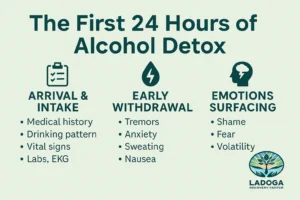
The first step is intake. That means gathering information:
- Medical history: illnesses, medications, allergies, prior hospitalizations
- Drinking pattern: how much, how often, what brand or strength
- Other substance use or prescription meds
- Mental health: past therapy, current diagnoses, any suicidal thoughts
- Physical baseline: labs, EKG if needed, liver and kidney function, electrolytes
Then vital signs: blood pressure, heart rate, temperature, oxygen. The team will watch for signs that your child is already in withdrawal or at risk of escalation. Sometimes the withdrawal begins before you even realize it—maybe tremors, anxiety, or nausea.
Once that groundwork is laid, they begin stabilization:
- Administering IV fluids or hydration if needed
- Introducing medication to ease tremors, anxiety, or nausea
- Nutritional supplements, vitamins, possibly small soft meals if tolerated
- Continuous monitoring: staff check vitals every few hours, keep an eye on changes
You may sit outside, waiting, pacing. You might not see most of this. But it’s happening. It’s the foundation of safety.
The body’s reckoning: early withdrawal and symptoms
Detox is the body re-learning how to exist without alcohol. In the first 24 hours, many symptoms stir.
Your child may experience:
- Tremors: shakiness in hands, arms—often the first sign
- Anxiety, restlessness, irritability: the mind presses urgency where there is none
- Sweating, chills: skin that flips between heat and cold
- Nausea, stomach discomfort: digestive distress as systems reboot
- Headaches or sensitivity to light/noise
- Restless body, insomnia or broken sleep cycles
For heavy drinkers, serious risks exist: seizures, falls in blood pressure, dehydration, electrolyte imbalance, even hallucinations or delirium tremens (DTs). That’s why detox must be supervised medically.
When you can’t be in the room, know that staff are watching for every shift—vitals, labs, mental status. Every tremor, drop in blood pressure, or sign of confusion is data they use to adjust treatment.
Emotions in motion: shame, fear, volatility
There’s a part you might not see, but you’ll sense—the emotional flooding, the internal fight.
Your child may swing from confidence (“I can do this”) to terror (“What have I done?”) in minutes. They may cry, rage, curse, retreat. They may push you away or try to talk through feelings they don’t fully understand.
You may hear:
- “I can’t believe I’m doing this.”
- “I’m so ashamed.”
- “I’m scared I’ll fail.”
- Silence, flat eyes, withdrawal
It is painful to hear or feel. But these emotional storms are part of detox’s unraveling. The substances that used to mute everything are gone. Now raw systems—nervous, shame-laced, anxious—are awake.
Your job in that storm is not to fix. Your job is to stay calm enough to be safe. To believe, to witness, to anchor when everything wobbles.
Communication: how to reach, when to wait
You’ll want to call. To push through. To be seen. But detox has its own rhythm—and your voice must negotiate with that space carefully.
Here’s what tends to help:
- Short check‑in messages: “Thinking of you,” “You’re not alone,” “I believe in you.”
- Avoid heavy emotional demands when they’re fragile (“Please talk to me,” “You broke me”)
- Ask staff when communication windows open—they often reserve times for family updates
- Letters or notes can sometimes be safer than calling or video
- Realize silence doesn’t always mean harm—it may mean their mind is overloaded
One parent told me: she carried index cards in her pocket with a few one‑line messages. When her child’s phone went dead, she left that card behind. Later, that note became a bridge back.
What parents can and should ask
You are part of this moment. You deserve clarity. You have rights to inquire—without shame.
Some questions you can ask staff:
- What is the withdrawal protocol being used here (medications, schedule)?
- How often will they monitor vitals or labs?
- What red flags would you call me about?
- When might I be permitted to visit or speak with them?
- What comfort measures are available (blankets, quiet rooms, soothing staff)?
- Will there be a family orientation meeting or debrief soon?
A staff member once told parents: “Ask until you see it. Don’t stop asking until you feel safe yourself.” That matters. It’s your child. You deserve transparency.
When you may hear from clinical staff
It’s normal to receive updates—sometimes urgent ones—in the first 24 hours.
You might hear:
- If a lab result shows danger (low sodium, high potassium, kidney stress)
- If vital signs shift unexpectedly or too fast
- If withdrawal intensifies beyond expected
- If your child refuses medication or treatment
- If the medical team needs your input or consent for interventions
Also, many programs schedule a family meeting early—sometimes day one or two—where you can ask questions, learn what’s ahead, and feel less like you’re in dark.
If you don’t hear, don’t panic. Silence may mean things are stable—or the medical team is focused on your child’s care. But you can always reach out and ask for a brief check.
What you might feel—and how to carry yourself
This day is not just about your child. It’s about you, too. Your fears, your guilt, your longing—all alive now.
You may feel:
- Shame or guilt: “Where did I fail?”
- Fear: “What if something goes wrong?”
- Powerlessness: “I can’t fix this.”
- Hope and terror tangled together
- Sleeplessness, nausea, preemptive grief
You are allowed all that. And you are allowed to feel it without collapsing. You are allowed to find small moments of calm—breaths, steps, prayers, walks.
One mother said: “I told myself I only had to see them survive the next hour.” Sometimes breaking it into small units keeps the weight manageable.
What this first day establishes for the days ahead
The first 24 hours are not just a trial. They set direction.
If your child stabilizes, the body can begin healing. Sleep may begin to return. Their system starts rebalancing. Their mind will gradually clear around the edges.
Medical interventions done well, emotional storms held, communication paced—all feed trust.
It’s not guarantee. But it is a start. It’s the first act in a new story.
You did something fiercely loving today—you acted when so many seconds begged inaction. You put your child’s safety first, even though your heart didn’t want to watch. Today is not done. Tomorrow will ask more. But today, you gave them rooms to breathe, bodies to steady them, eyes that watched over.
I won’t lie: the hours ahead are uncertain, heavy, sometimes cruel. But within them, possibility flickers. Lives do shift. Healing does begin.
You can’t “make” it all good. But you can stay grounded, hopeful, demanding honesty, offering love. You can hold your heart steady—even when every beat feels fragile.
If you’d like to walk alongside someone who knows this path, call (888) 628‑6202 or visit our Ladoga alcohol detox services. I hope this helps you feel less alone tonight—and maybe, hold a little more courage for what comes next.