


When your child’s behavior stops feeling like a phase and starts to feel like a medical emergency, your instincts kick in.
You’re not imagining things. You’re not overreacting. And no—you’re not the only parent whose kid went from “just having a hard time” to barely functioning.
Maybe your daughter hasn’t left her room in three days. Maybe your son is punching holes in the wall or accusing you of things that don’t make sense. Maybe they’re screaming, shutting down, talking about dying—or just… gone behind their eyes.
Whatever your version of crisis looks like, one thing’s clear: outpatient therapy isn’t cutting it. You need real help, and fast.
That’s where a residential treatment program comes in—not as a punishment, not as a retreat, but as a clinical intervention.
At Ladoga Recovery Center, we provide this kind of care for families across Terre Haute and Montgomery County who’ve run out of ideas and need medically guided stabilization—not just emotional support.
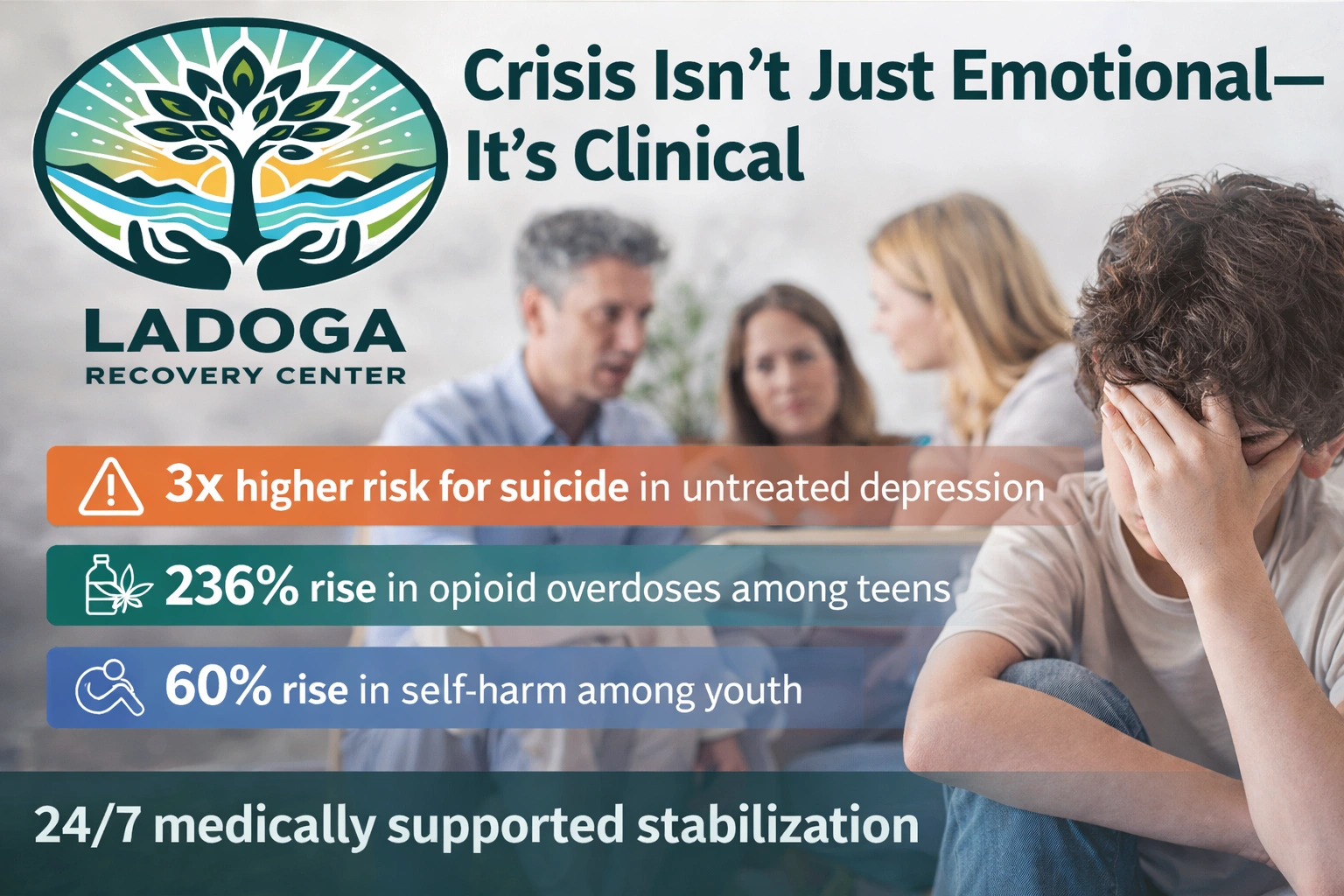
Crisis Isn’t Just Emotional—It’s Clinical
There’s this moment that hits every parent in crisis:
“I can’t fix this with love anymore.”
And that’s not because you failed. It’s because what your child is going through is not just emotional—it’s medical. Psychiatric crises, trauma reactions, psychosis, self-harm, and substance-induced breakdowns are not “just phases.” They are full-body, whole-system emergencies that require clinical containment.
If your child had a seizure, you’d take them to the ER.
So when your child’s behavior is erratic, dissociative, aggressive, or terrifying—you’re not wrong for needing a higher level of care.
Residential treatment programs are designed for exactly this: when things are no longer safe or sustainable at home, but you also don’t want to traumatize your child by sending them to a psychiatric hospital. This is the middle road—medical care with compassion.
Why Outpatient Isn’t Enough for Crisis Situations
Therapy is wonderful—when it’s enough. But when a young adult is in full-blown crisis, outpatient care can’t contain what’s happening.
A once-a-week therapist, even one they trust, isn’t equipped to manage:
- 3 a.m. panic attacks or violent outbursts
- Disordered eating that’s spiraling into physical collapse
- Suicidal ideation that shifts hour by hour
- Daily weed or alcohol use masking psychosis or trauma
- Refusal to take meds or engage with any support at all
Outpatient care is not a holding environment. But a residential treatment program is. It provides 24/7 support in a safe, enclosed setting where clinicians can actually observe and treat what’s going on—not just guess from reports.
A Residential Treatment Program Is a Medical Container
This isn’t rehab. It’s not a youth camp. It’s not a place to “figure things out.”
It’s a clinical setting where your child receives:
- Round-the-clock supervision by trained mental health staff
- Medication evaluation and stabilization (if needed)
- Structured daily routines to reduce chaos and support healing
- Therapy designed for crisis, not just talk therapy
- Peer support from others who are also in acute pain
We’re not here to pathologize your child or shame them into change. We’re here to help them stabilize—gently, clinically, and consistently—until they can safely participate in deeper work.
What Parents Often Say (and What We Say Back)
“They won’t agree to go.”
You’re not the only one in this position. We regularly work with families to facilitate compassionate intervention. And sometimes, when safety is urgent, residential care can be arranged without full client buy-in (especially if they’re under 18 or considered gravely disabled).
“What if they hate me for this?”
They might—at first. But over time, many clients come to see that the person who got them here was the one who didn’t give up.
“I should have done this sooner.”
Maybe. But you’re doing it now. And that matters more than anything.
The Environment Alone Can Shift Everything
Something happens when a young person enters a space that’s built for crisis:
- Their body starts to calm.
- Their defenses lower—because they don’t have to perform anymore.
- The blame cycle between parent and child starts to break down.
- A team—not just one therapist—is tracking them.
- They stop surviving and start stabilizing.
One mom told us:
“The first night I didn’t get a 2 a.m. call, I finally cried. Not because I was scared—because I knew she was safe.”
That’s what containment can do. It doesn’t cure everything. But it stops the spiral.
If you’re looking for the right level of care in Indiana that matches the intensity of what’s happening, we’re here to help.
This Isn’t a Parent Problem—It’s a System Problem
Your child is not “broken.”
You are not “bad.”
Your family is not “beyond repair.”
We see this every day: sensitive, loving parents who’ve exhausted every option, who feel ashamed to even consider treatment. And yet, it’s the most loving thing you can do—to step out of the role of fixer and into the role of responder.
Because sometimes the best way to parent… is to pause. To create space. To let a team step in.
That’s not giving up. That’s trauma-informed love.
What Happens After Residential?
You don’t have to have it all figured out right now. But here’s what you can expect:
- A clear clinical picture of what’s actually happening with your child
- A personalized treatment plan that continues beyond residential care
- Referrals to outpatient therapy, IOP, academic re-entry, or sober living if needed
- Family therapy that helps you heal alongside your child
- A step-down plan that doesn’t drop your kid into chaos the day they leave
This is not the end of the road. It’s the bridge.
FAQs: Residential Treatment for Teens and Young Adults in Crisis
Is this the same as rehab?
No. Residential treatment can address substance use, but it’s also designed for mental health crises, trauma, suicidality, disordered eating, and psychiatric instability.
Does my child have to agree to go?
Not always. If your child is under 18, you can typically admit them without consent. For adults, there may be involuntary hold options if they meet certain criteria. We can help you understand your options.
How long is the stay?
Typically between 30 and 90 days, depending on severity, insurance, and progress. Our team adjusts the plan based on your child’s clinical needs.
Will I be involved?
Yes. Family therapy, updates, and ongoing parent support are part of treatment. We believe healing happens in systems—not silos.
What if I don’t know what’s wrong with my kid?
That’s common. Our team specializes in differential diagnosis, trauma assessment, and helping families make sense of confusing behavior. You don’t need a label to start getting help.
How do I start?
Call us. We’ll walk you through your options, insurance, logistics, and whether residential care is the right level of support for what’s happening now.
You’ve tried love, logic, and waiting it out. It’s time for treatment.
Call (888) 628-6202 to learn more about our Residential treatment program in Indiana.